1. Select a discrete app icon.








notes

Around the world, so-called “fathers’ rights” groups are pushing legislation mandating a presumption of evenly shared, 50/50 child custody. In states where there is no legal presumption of 50/50 custody, a judge can still award it. And they do, all the time. Without the 50/50 presumption, judges should base rulings on the best interests of the child. When 50/50 becomes the default, it can be difficult for judges to protect children from a domestically abusive parent
While these 50/50 bills may sound “fair,” they disadvantage mothers and children for three main reasons:
Coercive control researcher, Dr. Mei-Ling Ellerman, notes that most domestic abuse perpetrators are men and most domestic abuse victims are women. Domestic abusers often change their strategies post-separation to retain power over their victims. Seeking equal child custody, abusers use fabricated concern about the mother’s “lack of parental fitness” to disguise their abusive litigation and communications.
Ellerman notes that abusive fathers stand to benefit from these 50/50 custody bills, many of which alter the definition of “child’s best interests” to include the presumption of joint custody with equal parenting time. Domestic abusers’ attorneys use these bills to pressure judges to overlook child protection in favor of the abusers’ “parental rights.”
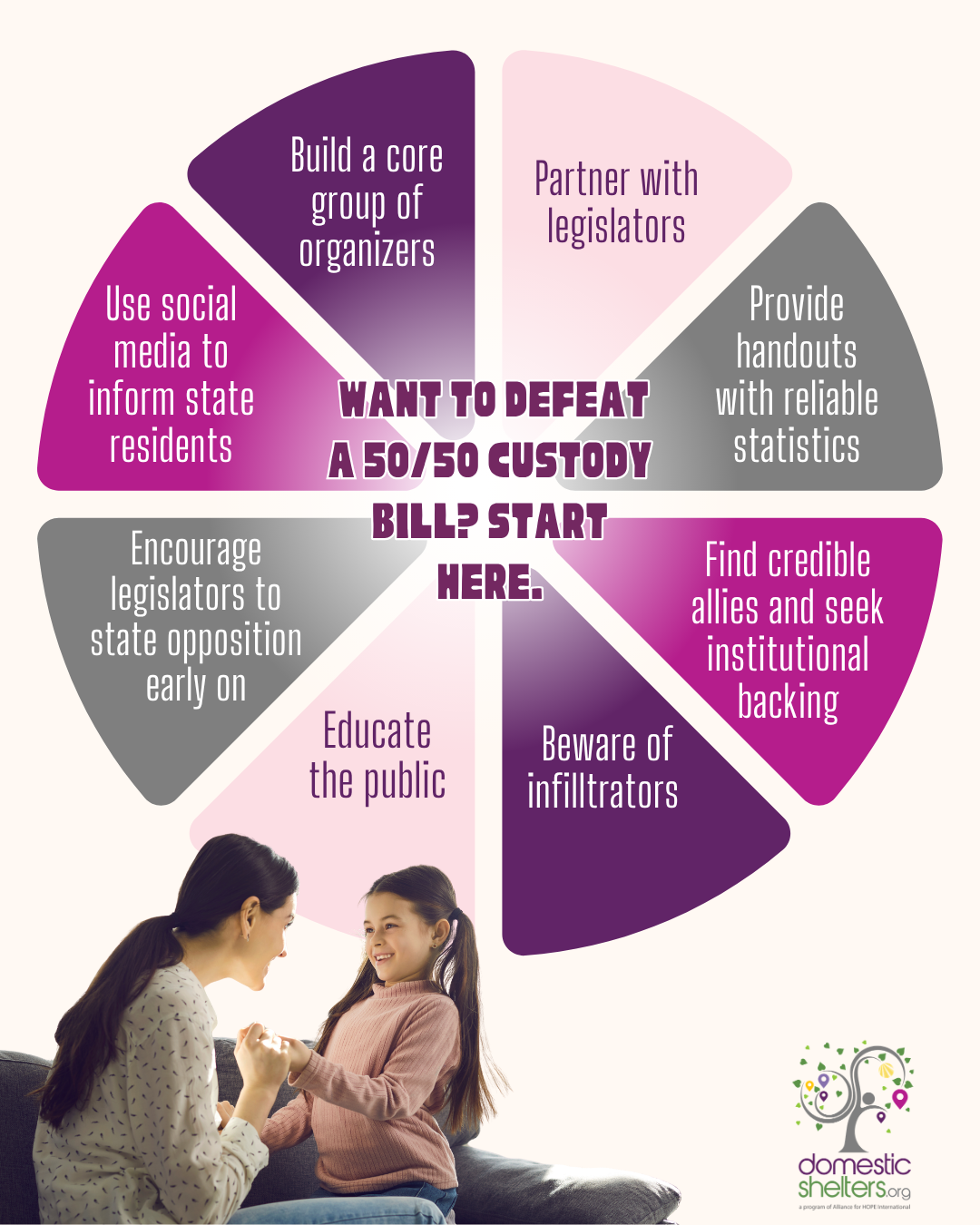
A coalition of Colorado moms and organizations recently defeated a bill proposing a 50/50 presumption. Here are some tips from their experience:
Build a Small Core Group of Organizers. The core group helps guide the less experienced members. This is important because overly emotional personal testimony is less effective. Additionally, people who testify in detail about their own personal experiences may face legal repercussions. This small group can organize survivors to testify both in writing and orally when the hearing is scheduled.
Partner with Legislators. Your state domestic violence coalition can help you identify legislators who have sponsored bills related to domestic violence and who might be open to hearing about the dangers of 50/50 presumptions. Ideally you will have legislators from both major parties, both the House and the Senate, and various regions in your state.
Encourage Allied Legislators to State their Opposition Early On. A lot of the action that matters happens behind the scenes. These legislators can help build momentum to oppose these bills.
Find Credible Allies to Provide Information. Knowledgeable attorneys, judges, scholars, advocates and survivors can provide information in a variety of ways. They may be willing to serve as points of contact for the media, legislators and aides.
Beware of Infiltrators. In some states, so-called father’s rights groups have secretly wormed their way into meetings of protective parents. In these settings, they have engaged in misinformation, changed the groups’ direction and gathered contacts and information to use for their own ends. Make sure you study groups and people associated with groups that "sound good" carefully before you invite people to meetings or sign their petitions. Sometimes organizations and people "sound good" but have ill intent.
Seek Institutional Backing. In Colorado, a broad group of organizations including Violence Free Colorado, the Colorado Coalition Against Sexual Assault, and the Colorado Bar Association Family Law Division all testified against the bill. Your state District Attorney Fatality Review Board could also be involved, as could women’s bar associations, and child welfare organizations.
Use Social Media Strategically to Inform State Residents About the Progress of the Bill. Try not to allow this social media to be taken over by people who want to tell their personal stories. Although this can be empowering, they may put themselves and their legal cases at risk through this public exposure. (Judges often punish parents who take custody battles into social media).
Provide Handouts with Reliable Statistics. Make a fact sheet available to legislators and their aides in advance of the hearing and on the day of the hearing itself. Make sure your information comes from reliable sources such as legal journals and peer-reviewed studies.
Educate the Public: Hold video calls with domestic violence advocates, protective parents and child welfare organizations in your state to educate them about the proposed bill and the upcoming hearing.
Enlist the Media. Write letters to the editor in your state and local newspapers. Contact reporters who you think are apt to understand the issues, encouraging them to write about the proposed bill. The process of educating state residents about the upcoming bill should be informative and empowering. Remember, there will be future bills to propose and defeat.
Hold Broad Virtual Meetings to Prepare for the Legislative Hearing(s). Appoint a member of the leadership team to promote clear messaging and agreement on tactics. Typically, each speaker at a legislative hearing will be allowed only two minutes to speak. Guide speakers to condense their language and protect their own legal cases by not revealing too much personal information in public. Survivors can be protected as they testify if you can arrange in advance for them to be able to testify virtually with their cameras off and using a pseudonym.
Make Sure Testimony is Credible, Concise and Focused. Tips include staying positive, focusing on the impact on children, and having each person’s comments add on new points, to avoid duplication. Focus on legal reform rather than complaints about the current system. Avoid mentioning specific attorneys or judges. Encourage people to practice and time their comments. Speakers can ask AI tools to edit comments down to two minutes.
Cite State Family Court Data. The Colorado Fatality Review Board studied and testified about the number of child and intimate partner fatalities that occurred in families that were involved in the family courts. This made for compelling testimony. In Colorado, a mother whose children had been killed by their father during court-ordered parenting time testified as well. This testimony underlined the seriousness of the issue.
Most couples decide custody arrangements without a legal battle. Abusive fathers are more than twice as likely as non-abusive fathers to seek sole custody of their children. This is often an attempt to punish the children’s mother, avoid paying child support, and “win,” rather than a sincere desire to spend time with the child. About half of cases where fathers fight for custody include documented domestic violence. In these situations, mandating 50/50 custody compels mothers and children to maintain close contact with the abuser. This exposes child and adult abuse victims to continued and sometimes fatal risk. Increasing numbers of children are killed by their domestically abusive fathers after parental separation.
Right-wing powerhouses such as The Heritage Foundation support 50/50 custody presumptions because they make it harder for women to leave marriages. While it can seem hard to imagine defeating such large and wealthy organizations, the well-coordinated folks in Colorado did just that.
If you’re facing a custody battle with an abusive spouse, you don’t have to go at it alone. Reach out to a domestic violence advocate near you for advice, safety planning and legal resources. Or use our Hope Chat feature on DomesticShelters.org to direct you to relevant information regarding legal matters and family court.

Welcome, this is your discreet connection to help.
You are safe here.
Menstruation is an experience shared by
generations of women across the globe.
Sadly, abuse is another commonly shared experience between women.
Be it physical or psychological, abuse is not OK in any form.
Period.
You are not alone.
Help is just a few clicks away.
Welcome to DomesticShelters.org, a trusted Bright Sky US partner. On DomesticShelters.org, you will find free domestic violence resources such as:
The Bright Sky US website is still open on your browser in a separate tab, so you can return to the Bright Sky US website anytime.


