1. Select a discrete app icon.








notes

This article was originally published in 2011. It was updated in 2026.
For people on the outside of abuse, it can be one of the most frustrating questions to answer: Why doesn’t someone just leave an abusive partner? The harm may be obvious and the risks undeniable. But what’s often invisible is the powerful psychological bond that can form in these situations—one that makes leaving far more complicated than it seems.
Known as trauma bonding, this attachment is not a sign of weakness or poor judgment. It’s an explicable human response to cycles of harm and occasional hope. It’s something abusers orchestrate and weaponize. Understanding it is key to understanding why people stay–and helping people escape.
Trauma bonding is a type of attachment that one can feel toward someone who’s causing them harm. It brings with it not only feelings of sympathy, compassion and love, but also confusion, says licensed mental health counselor Stefanie Juliano, LPCC.
“It can become a cycle of, if I’m loved, I’m abused; it’s my fault and I need to please them,” says Juliano. “Many don’t even make the connection that they are, in fact, being abused.”
Trauma bonding is different from shared trauma in which two people feel a deep connection after going through something traumatic together. Trauma bonding is something that can happen in relationships where one of the people in the relationship is abusive.
In this article, we’re discussing trauma bonds as they occur in intimate partner relationships, but trauma bonds can be orchestrated between a child and an abusive parent, within a cult where followers are trauma bonded to the leader or in the workplace where employees may feel loyalty to a toxic boss.
Intermittent reinforcement is what keeps many survivors attached to an abusive partner in a domestic partnership. This could look like promises that the abuser will change, get help, get sober or—with the survivor’s help—turn things around. The survivor holds on to hope that things will go back to how they used to be before their partner’s abuse began.
Only, those promises often fall short. More often than not, tensions begin to build and another incident occurs where the abuser causes harm. The abuse may be emotional, psychological, verbal, physical or sexual. In all cases, the survivor feels unsafe again, but still hangs on to the possibility that this will be the last time.
Trauma bonding can include elements of brainwashing and gaslighting by the abuser. A survivor may feel disoriented and conflicted, unable to discern what’s real and what’s not. They may doubt their own memories of abusive events or minimize them as a form of self-protection.
There’s also a chemical component at work. If there are moments where the abuser is apologetic, kind or romantic, a survivor’s brain receives a rush of dopamine, the feel-good chemical released during activities you enjoy. It can also be released when someone expects a reward—think about that rush you get when you see a gift for you, before you open it. Many of us repeat activities we know will bring us a dopamine release. Some of these are healthy activities—eating chocolate, going for a run or meeting up with friends—while others are not so much, like staying with an abusive partner and expecting them to change.
Your brain can also become “hijacked” through addiction, causing a surge of dopamine to flood your nervous system when you continuously repeat a pleasurable activity. People can become addicted to drugs, alcohol, gambling, shopping, social media—but also, individuals they care about. The trauma bond occurs when a survivor feels desperate for that next surge of dopamine and will stay in situations they know are harmful.
If you think you might be experiencing trauma bonding to an abusive partner, read through this list of signs and see how many sound familiar:
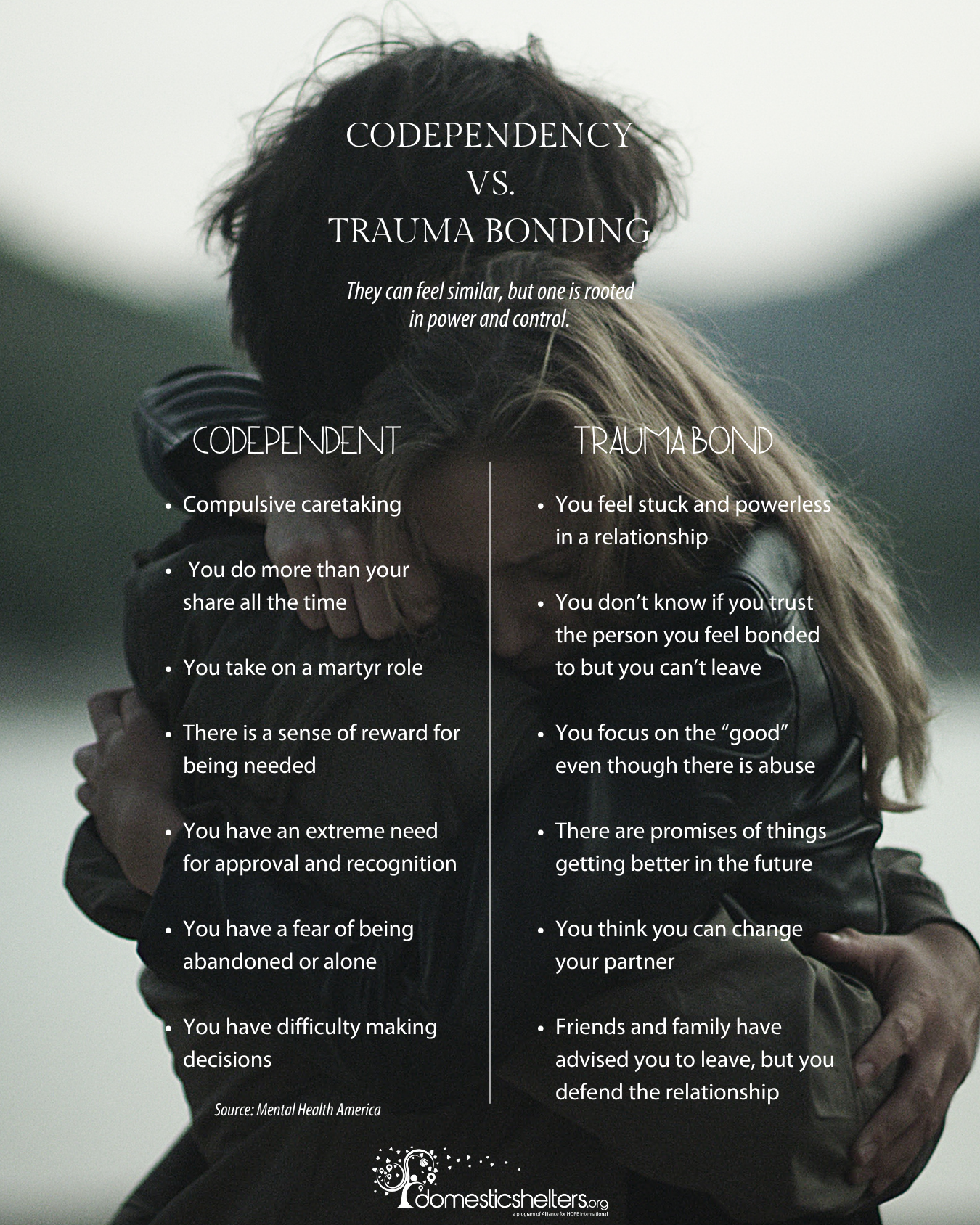
There are a few suspected reasons why some survivors experience trauma bonding and others don’t.
Childhood Abuse. Trauma bonding can happen for a variety of reasons but some experts, including Mo Therese Hannah, Ph.D., chair and co-founder of the Battered Mothers Custody Conference, and professor of psychology at Siena College, believe it can have roots in childhood. Children with abusive parents may grow up to find familiarity in an abusive partner, feeling a sense of normalcy being abused.
“Many of these survivors were abused as children, often by their father, whom the abuser may remind her of on an unconscious level,” says Hannah. “She hopes that this time, as opposed to during her childhood, she will be loved and treated well.”
Obligation. Hannah says trauma bonding can also occur when the victim feels a sense of obligation to the abuser. “Certainly not all, but especially in instances where a female survivor became bonded to her abuser in her youth ... she feels dutiful and obligated to him and, in most cases, at least for a while, he has treated her well,” says Hannah. “He may have been her ‘first great love,’ making her reluctant to leave him, believing in his potential or his capacity to return back to the way he used to be."
Survival Technique. Hannah says trauma bonding has similar traits to Stockholm syndrome, a term originally created to describe how victims of kidnapping can begin to feel a connection to their captors over time. Psychotherapist Paul Hokemeyer says Stockholm syndrome, or trauma bonding, are survival techniques.
“Rather than place themselves in an escalating cycle of violence, [victims] consciously and unconsciously figure out ways to deescalate and resolve the conflict. In its most basic sense, this is seen as surrendering to win. The victim gives into the source of violence and aligns with it. In so doing, they feel protected by their perpetrator rather than hostile with them.”
Says Hannah, “Some women [who experience trauma bonding] actually defend their abuser, protecting him from others' criticisms. She may do this out of fear or misplaced loyalty, or maybe even out of magical thinking, that if she is loyal and protective of him, he will be the same way toward her.”
Barriers to Leaving. Whenever possible, abusers will set up barriers to a survivor leaving them. Abusers create financial dependence by not allowing a survivor to work or have access to shared money, they may isolate the survivor in a remote location with few resources and they may alienate friends and family so the survivor feels she has no one who will believe her. All of this, plus many other possible barriers, can keep a survivor feeling like staying with the abuser is their only option.
Escaping a trauma bond starts with recognizing you’re in one. If the points in this article sound familiar, you can find reassurance that the trauma bond is not your fault—the abuser has helped to orchestrate it. Trauma bonding is not a weakness but rather a survival response that your brain is using to help protect you.
Here are some steps to take after recognizing a trauma bond is occurring.
It will help to start keeping a record of the abusive incidents your partner is inflicting so you can more clearly see their cycle or frequency of abuse, or notice their escalation. Consider keeping a log at your place of employment or a relative’s house where the abuser can’t locate it. There are also smartphone apps that can help you safely keep your records handy. This may also come in handy as evidence in court later on.
There’s no single “right” way to do this—only what is safest and most realistic for you. Safety can look like many things—separating yourself emotionally from the abusive partner while still living together or making a plan to leave with support from a trained domestic violence advocate. If physical separation isn’t possible or safe right now, creating small pockets of space can help: limiting your interactions and discussions with the abuser to those only absolutely necessary (like when coparenting children), spending time with trusted friends or family or connecting with a support group. An advocate can help you explore options and build a plan that prioritizes your safety, whether you choose to stay or leave.
An abuser almost always escalates, so when it’s safe to do so, separation is the goal. Once separated, avoid all contact with the abuser. Do not respond to texts, phone calls or emails. Delete or make your social media accounts private and do not check your partners’ accounts. Separation will help you to more clearly see what you may have been trapped in and give you time to figure out what you’d like to do next.
Abuse can make you feel lost and unsure of who you were before the relationship. Spend time doing things that remind you of who you were before an abuser eroded your sense of self. Maybe there was a hobby you used to enjoy or a person you want to reconnect with. It can also help to ground yourself through meditation or simply quiet times where you can reflect and regain your sense of reality.
After abuse, it may sound almost unfathomable that you could miss your abusive partner. But trauma bonding included both negative and positive reinforcements. It’s only natural that detachment takes time. Your brain is detoxing from that dopamine rush. Remember that future relationships with healthy partners may feel “boring” in comparison—that’s a good thing. After a while, your brain will start to register safety as the true reward, not chaos.
To find support in understanding abuse and getting to safety, visit our Get Help page to locate a domestic violence organization near you with advocates ready to listen. Or use Hope Chat, our AI assistant located at the bottom of your screen. Hope Chat can help lead you to articles on our site that explain abusive tactics and safety solutions in more detail as well as connect with a domestic violence advocate who can help.
Your support gives hope and help to victims of domestic violence every day.

Welcome, this is your discreet connection to help.
You are safe here.
Menstruation is an experience shared by
generations of women across the globe.
Sadly, abuse is another commonly shared experience between women.
Be it physical or psychological, abuse is not OK in any form.
Period.
You are not alone.
Help is just a few clicks away.
Welcome to DomesticShelters.org, a trusted Bright Sky US partner. On DomesticShelters.org, you will find free domestic violence resources such as:
The Bright Sky US website is still open on your browser in a separate tab, so you can return to the Bright Sky US website anytime.


