1. Select a discrete app icon.








notes

This piece was originally published in 2015. It was updated in 2026.
It sounds simple—leave an abusive partner, start fresh and give yourself and your children a better future. But for many survivors of domestic violence, leaving isn’t just a matter of choice. Financial barriers, housing instability and the looming question of whether you’ll be safe can make leaving feel impossible.
Abusers know that without money, survivors’ options of escape are limited. Unless a survivor has a family member or friend who is willing to take them in—possibly at their own peril— a survivor is left with two choices: turn to a shelter or forge a way on her own. And if the abuser has made sure the survivor has no access to her own money, the latter can be an almost insurmountable challenge.
Here are some estimated national averages that show the real challenges survivors face. Consider that almost all abusers utilize financial abuse, restricting a survivor’s access to money or refusing to pay child support.
This total is $1,435 higher per month than when we first ran this article in 2015. That means it costs over $17,000 more per year to live in 2025 than it did a decade ago. Yet the average income of a single parent has only increased by $5,000—from an average of $40,000 in 2015 to $45,000-$50,000 in 2025.
If you break that down monthly, a single parent may be looking at an average paycheck of around $4,166 before taxes per month. It doesn’t take a mathematician to see why a lot of single parents aren’t able to make ends meet. In many U.S. cities, the cost of living far exceeds the average single parent’s income. And for women survivors, consider that women still earn just 62 cents for every dollar earned by men.
“I’m asked all the time, ‘Why do they stay?’” says Lucille Powell, domestic violence counselor with the Community Action Program of Lancaster, Penn. For many survivors, it comes down to deciding between keeping oneself safe and keeping one’s children fed and clothed.
“I see it every day,” she says. “It’s not just the cash. If you have a partner who refuses to pay child support or drags that out, it can become a vicious cycle of leaving and returning."
As a result, survivors can face victim-blaming and shame from those outside of domestic violence who don’t understand the barriers to leaving. The self-blame can compound the already low self-esteem that the abuser made sure to instill. It’s the perfect storm to keep the survivor down on herself and trapped. But not if she has the right support.
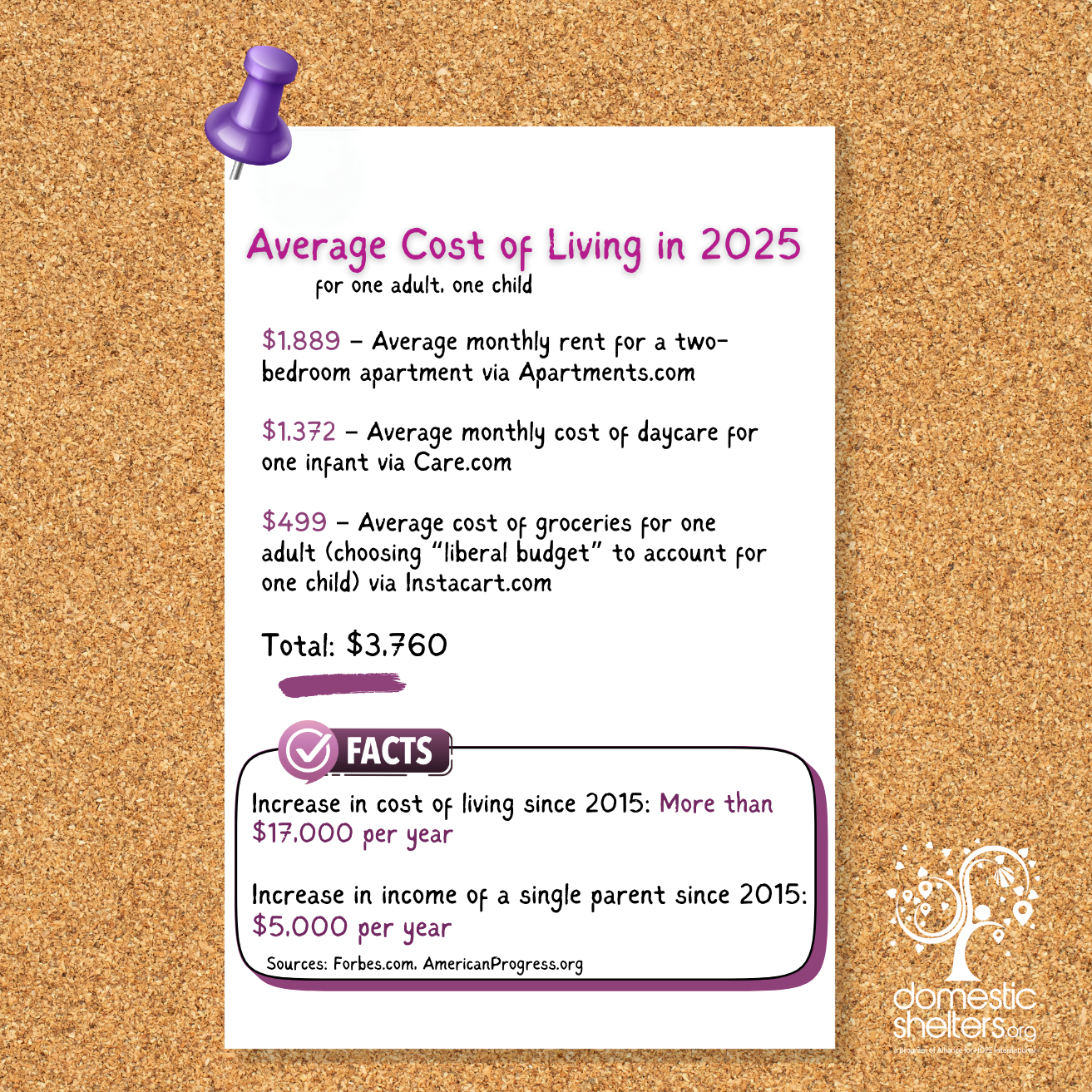
While financial preparedness is the first step—taking stock of current finances and figuring out what kind of budget you’ll need to live from, sometimes even securing a “good” job won’t cut it. Currently, only 32 states offer a minimum wage of over $10. While the federal minimum wage is $7.25 an hour, working a 40-hour week, five days a week would earn an individual under $1,200 a month, not even enough to cover childcare, much less a place to live or food. Americans have long demanded more affordable housing and a livable minimum wage—but nowhere is this more urgent than in a home where leaving can mean the difference between life and death.
One would expect a partner to pay child support after separation, but abusers often use the court system against survivors, finding savvy and seemingly unfair-but-legal ways to skirt the obligation. Or they outright refuse to pay. Some mothers are afraid to seek child support or accept far less than the legal requirement out of fear that the abuser will respond by seeking custody.
Add to that the fact that many abusers may then use the legal system to bring frivolous motions against the survivor, dragging them to court to cost them money. Why? It’s an easy way to torture the survivor but the abuser also hopes that by weaponizing even more financial abuse, the survivor may return out of desperation.
It’s not going to be easy, but it’s going to be worth it. Those are words echoed by survivors time and time again that we’ve spoken to who have escaped abusive partners. Survivors should first know that there are people and organizations ready to help. You just have to ask. Below are some options to check out.
A Family Justice Center is a singular location where survivors of domestic violence, sexual assault, child abuse, human trafficking and elder or dependent adult abuse can find all of the services they may need. This can include legal support, such as orders of protection or filing charges, trauma counseling, safety planning, childcare, basic needs like clothing, temporary shelter options and career support.
You can find Family Justice Centers near you with this search.
A domestic violence shelter can offer a temporary, safe and confidential living space while a survivor decides on a more permanent option. While at shelter, it can give a survivor time to look for other resources, such as subsidized housing, rapid rehousing or options in other cities or states that may be safer and further away from the abuser.
You can find a shelter near you with our Get Help tool.
An order of protection can not only protect a survivor from the abuser contacting and harassing her, but can also prevent the abuser from hiding financial assets, closing financial accounts or selling property. A survivor can also ask for emergency custody orders and include child support payments in that request.
Domestic violence organizations, Family Justice Centers and other community organizations likely have financial assistance programs that can help survivors with anything from rent assistance to utility bills to food to diapers to clothing and more. You may also want to check with local churches who often have giving programs especially set up for women and children in need. Again, it never hurts to ask.
You can also call 211 if you are having trouble paying your utility or phone bills.
Escaping is the first step, but staying away is the next battle. To do that, a survivor will want to not only repair their credit (it’s likely the abuser has damaged it on purpose) but also educate themselves on the best way to build a solid nest egg. The internet is abound with free financial courses for women and survivors—just watch out for the scams that look free at first but try to sell you something later on.
Start here: “Finding Financial Footing After Abuse.”
Struggling with bills is not uncommon no matter what one’s circumstances. It’s important to make a household budget in order to know what’s coming in each month and what expenses you need to plan for. Remember that sticking to the budget means keeping yourself free from returning to an abuser.
To learn how to make a budget, see “Ask Amanda: How Do I Make a Household Budget?”
It’s OK, this can be overwhelming, but you’re not alone. Reach out to a domestic violence advocate at the shelter nearest you. They can help you create a safety plan, a contingency plan for any possible scenario that should arise when you’re ready to leave. You can also talk with our Hope Chat, the AI assistant that pops up on our home page. It can direct you to the right resources on DomesticShelters.org that can help you better understand different facets of abuse, how to leave safely and more tips for planning.
Your support gives hope and help to victims of domestic violence every day.

Welcome, this is your discreet connection to help.
You are safe here.
Menstruation is an experience shared by
generations of women across the globe.
Sadly, abuse is another commonly shared experience between women.
Be it physical or psychological, abuse is not OK in any form.
Period.
You are not alone.
Help is just a few clicks away.
Welcome to DomesticShelters.org, a trusted Bright Sky US partner. On DomesticShelters.org, you will find free domestic violence resources such as:
The Bright Sky US website is still open on your browser in a separate tab, so you can return to the Bright Sky US website anytime.


