1. Select a discrete app icon.








notes
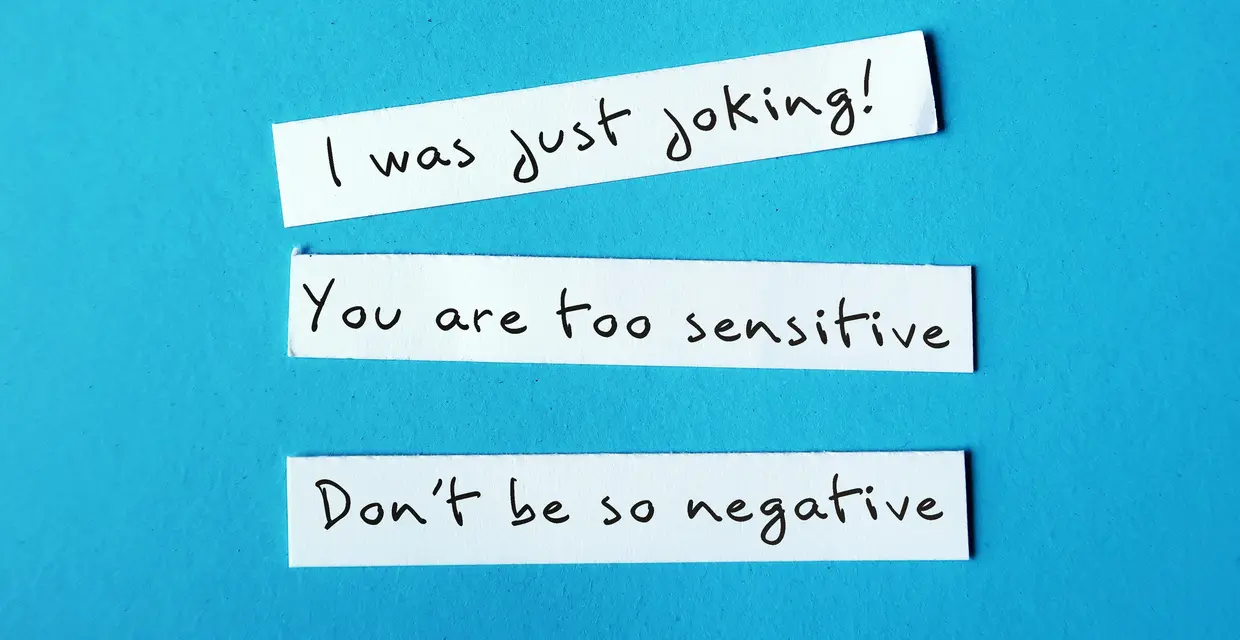
This story was originally written in 2015. It was updated in 2026.
1. Gaslighting distorts reality to create self-doubt. Gaslighting is a manipulation tactic that repeatedly denies, rewrites or minimizes a person’s experience, leading them to question their own memory and judgment.
2. It often works alongside other forms of abuse. Gaslighting is rarely isolated. It commonly appears within broader patterns of emotional, verbal, physical or sexual abuse and reinforces power and control in the relationship.
3. Recognizing the pattern is an important first step toward clarity and support. Noticing repeated confusion, self-doubt or reliance on a partner to define reality can be a sign of gaslighting. Outside perspective and support can help validate experiences and provide options for safety.
That’s not what happened.
You’re remembering wrong.
It was your fault.
There is something seriously wrong with you.
When a partner claims you’re remembering things incorrectly, it’s likely to drive you crazy. You know what happened in that fight. And you know it’s happened before. This type of tactic—an attempt to make one doubt their reality—is called gaslighting, and it’s often used as a form of abuse.
The name “gaslighting” comes from a 1930s play called Gas Light in which the main character attempts to drive his wife crazy by dimming the lights in their home, which were powered by gas, and then denies the lights are changing.
This type of psychological abuse is part of the pattern of power and control found in domestic abuse, says Janie McMahan, licensed marriage and family therapist. “Gaslighting makes [survivors] doubt themselves and not see the real issue, which is that they’re being abused.” It’s not uncommon that, after a while, a survivor will start to think, “Well, is this right? Am I really not justified in feeling this way?”
An abusive partner who uses gaslighting will deny things that clearly happened, even when others witness it. McMahan remembers sitting at dinner one night with a friend and her boyfriend, who was known to be emotionally abusive. “He called her ‘an f-ing bitch,’” remembers McMahan. When his girlfriend called him out on it, he replied earnestly with, “I didn’t say anything. You must be hearing things.”
Gaslighters twist facts around.They replay conversations or interactions in a way that makes themselves out to be the victim and blames you for what happened. This can be referred to as DARVO: deny, attack, reverse victim and offender. Suddenly, your partner yelling at you and shoving you against the wall is retold as you starting a fight, and them just trying to get away from your so-called tirade.
Gaslighters also use this tactic to minimize the abuse, saying things like, “You’re so emotional,” or “That was just a normal fight—all couples have them,” to make you question your reaction and downplay what happened. Over time, you may find yourself minimizing their abuse to others like friends or family.
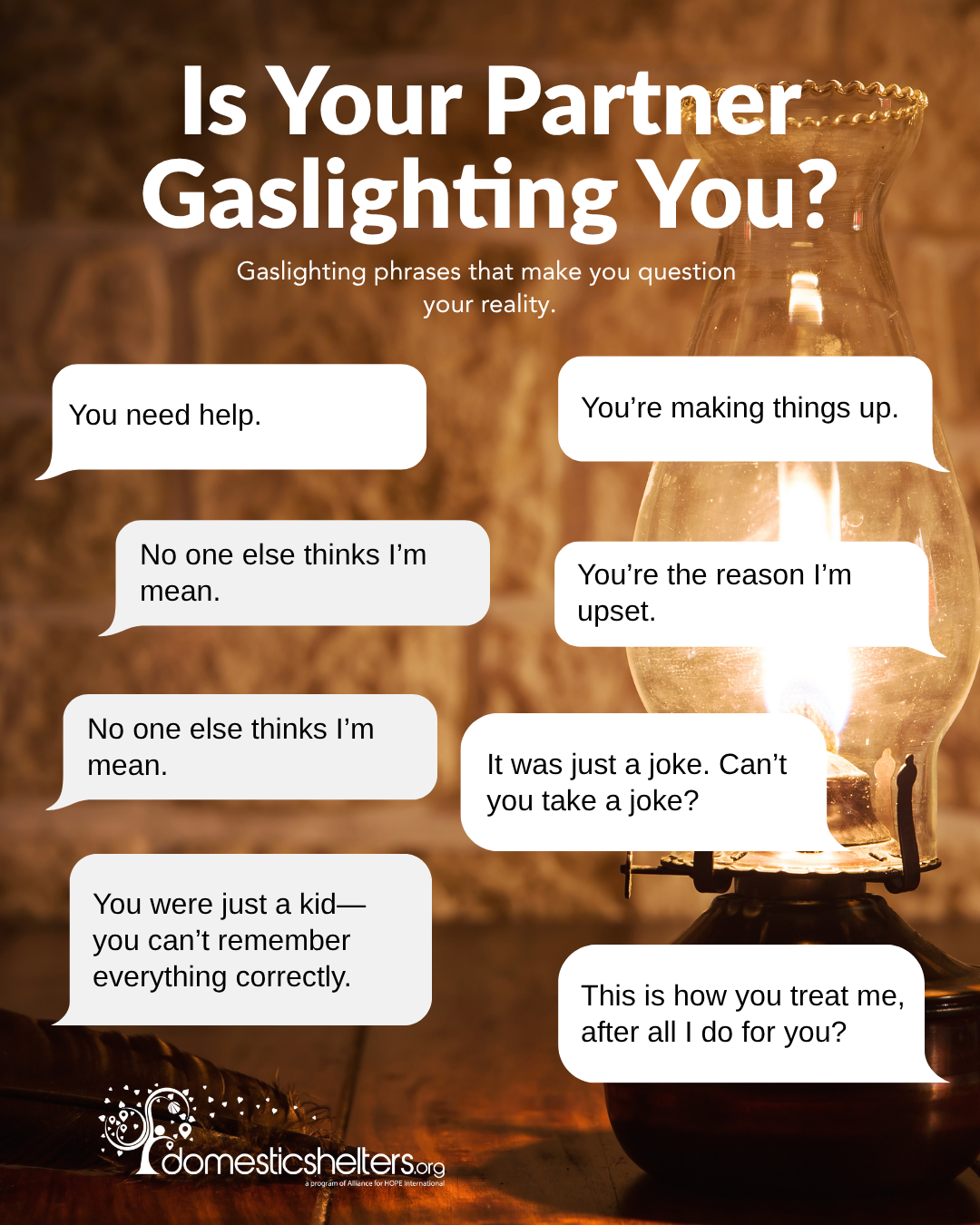
The language of gaslighting often overlaps with emotional abuse. The abuser is putting you down and rewriting history all at the same time. Some examples include:
This is often used when the survivor accuses their partner of infidelity.
Convincing the survivor that they’re the ones who are abusive and need to see a therapist is a common gaslighting trick.
Your partner is gaslighting you into believing that only you see them as abusive, which actually is often true. Abusers know how to turn on the charm around others and keep their controlling and violent side hidden behind closed doors. But you aren’t “crazy” or making things up.
Suddenly, you’re on the defense as your partner brings up mistakes in your past. The difference? Your actions are likely in response to their abuse.
The abuser is trying to avoid accountability and dismiss your version of what happened.
You might hear this from a parent or an abusive partner as you retell an abusive incident from your past. But while childhood memories can be imperfect, traumatic experiences are often vividly and persistently remembered.
This phrase is used as a guilt trip designed to make the survivor feel responsible or indebted for meeting their basic needs or relying on support.
Abusers use gaslighting to disorient their partners and make them doubt themselves and their memories. Ultimately, the tactic can keep a survivor trapped in the relationship, believing things aren’t as bad as they think they are or that the abuse is somehow their fault.
McMahan says gaslighting may also come at the start of a relationship. Abusers want their partners to begin doubting themselves from the get-go.
“They [survivors] begin thinking they’re a little bit ‘off,’ emotionally and mentally,” says McMahan. Essentially, they begin thinking they can’t trust their instincts. Their self-esteem can plummet. They feel less than the other person—less intelligent, less capable. McMahan says it can lead to the survivor not having a sense of self, believing they no longer have an identity or a voice.
“It keeps them in these relationships,” McMahan says.
You can begin to recognize gaslighting when you start questioning yourself constantly after an incident with a partner. It may help to begin writing your version of events down and then noting how your partner dismisses or disputes them. (Keep this log in a safe place where the abuser can’t find it.) You may begin to see a pattern, and likely, gaslighting isn’t the only tactic of abuse your partner is using. They may also be using verbal, emotional, physical or sexual abuse to control you.
It can also help to run your suspicions of gaslighting past someone you trust—a friend, family member or an advocate at your local domestic violence organization. As an outside perspective, they may be able to help validate what you’re experiencing.
To help determine if your partner is gaslighting you, ask yourself the following questions from our Guide to Gaslighting:
Over time, gaslighting can be very harmful to one’s mental health. It can cause:
Reaching out for help is always a solid choice when you’re having doubts about your partner and your safety. You can reach out to a domestic violence organization and share as little or as much as you want. You don’t have to be ready to leave or be seeking shelter to call a hotline.
If gaslighting comes early on in a relationship, know that the relationship is not healthy, says McMahan. It’s likely that other types of abuse will follow.
Lastly, know that gaslighting is a type of manipulation, says McMahan, and anyone can fall victim. “It happens across the board. It can happen to men and those in same-sex relationships. Gaslighting is very subtle. It’s not until you’re pretty deep into it that you realize it.”
Support is available if you’re trying to make sense of abuse or its impact. Visit our Get Help page to find a local domestic violence organization with advocates who will listen without judgment. You can also reach out through Hope Chat, our AI assistant at the bottom of your screen, to explore information about abusive dynamics and safety planning or to find an advocate for support.
Your support gives hope and help to victims of domestic violence every day.

Welcome, this is your discreet connection to help.
You are safe here.
Menstruation is an experience shared by
generations of women across the globe.
Sadly, abuse is another commonly shared experience between women.
Be it physical or psychological, abuse is not OK in any form.
Period.
You are not alone.
Help is just a few clicks away.
Welcome to DomesticShelters.org, a trusted Bright Sky US partner. On DomesticShelters.org, you will find free domestic violence resources such as:
The Bright Sky US website is still open on your browser in a separate tab, so you can return to the Bright Sky US website anytime.


