1. Select a discrete app icon.








notes

Many of us think of shelters as a one-size-fits-all solution for people in crisis. But the needs of a domestic violence survivor are fundamentally different from those of someone experiencing homelessness. For survivors, it’s not just about a bed—it’s about a place where their abuser can’t find them.
Yet, too many survivors face the dilemma of finding a safe place to go. And when their local domestic violence shelter is full—which most are due to a chronic lack of funding—they are forced to ask themselves, What now? Could I seek refuge at a homeless shelter? The answer is more complicated than it may seem.
A domestic violence shelter is temporary, emergency housing for individuals who need to leave an abusive partner. Most shelters house primarily women and children, the main victims of domestic violence, though most shelters also have emergency lodging options for male survivors. As opposed to most homeless shelters, a domestic violence shelter allows individuals to stay in shelter for weeks, if not months at a time and doesn’t require them to vacate during the day. Most also offer additional services such as crisis counseling, case management, legal help, childcare and pet boarding.
A homeless shelter is also a form of temporary, emergency housing for individuals and families who are unhoused. The term “unhoused” is preferred in order to focus on the systemic problem of lack of housing, rather than defining a person by their circumstances. Most homeless shelters are co-ed. And most are overnight shelters, meaning that individuals can stay the night but must leave during the day. Day shelters do exist, however, which offer refuge in daytime hours, though are less common. Homeless shelters may offer other services as well such as meals, a food and clothing bank and assistance with long-term housing options.
However, there are far fewer shelters reserved specifically for those escaping domestic violence than there are for the unhoused population in general. The DomesticShelters.org searchable database has over 2,700 some domestic violence nonprofits listed nationwide, including some in Canada. Domestic violence shelters have around 10 to 15 beds or units for survivors, with some having even fewer.
Meanwhile, federal homelessness counts report hundreds of thousands of beds in their yearly homelessness housing inventory reports. The numbers far exceed those resources available in domestic violence-specific housing.
Maricela Rios-Faust is the CEO of Human Options, a domestic violence advocacy organization in Orange County, Calif. As part of their survivor-supportive services, they have a 15-unit emergency shelter, as well as two additional locations that offer short-term housing. Most times, says Rios-Faust, their shelter is at capacity.
This isn’t unique—according to an annual one-day census of individuals seeking help for domestic violence, conducted by the National Network to End Domestic Violence, more than 13,000 requests for help were not able to be met by organizations because of a lack of resources, funding or staffing. Of those, more than half were survivors seeking emergency shelter or other housing.
When the shelter is full, Rios-Faust says advocates talk through alternatives with survivors. This might mean thinking of a friend or family member who could provide refuge, though that presents its own risks.
“Sometimes, we’re able to offer them a hotel while they wait for a unit,” she says. “Or we refer them to a homeless shelter or a shelter provider. Ultimately, they choose where they’re going.”
Not all shelters offer the same kind of safety. Here are the key differences between a homeless shelter and a domestic violence shelter:
Anyone experiencing abuse can seek refuge at a domestic violence shelter, but typically, shelter hotlines will prioritize beds for those most imminent risk of escalating violence. Most domestic violence shelters take in female victims and their children but offer housing alternatives such as hotel rooms to male survivors, though some also have housing options for male survivors. A survivor’s pets may be welcome at domestic violence shelters, depending on location.
Anyone who does not have a permanent, stable or safe place to stay qualifies for a homeless shelter. This can include people who live on the street or in their car, those facing eviction, individuals escaping violence at home, or those who “couch hop” between different residences that are not their own. Different shelters have different guidelines on who they house. Some cater to specific groups, such as families, youth only or veterans. Shelters should not require identification or proof of citizenship to seek help.
Transitional housing describes housing that’s offered at an affordable or subsidized rate to unhoused individuals and families, including survivors of domestic violence, for a set amount of time until they can get secure, safe housing of their own. Transitional housing comes in many forms, including shelters, apartments or hotel rooms, depending on what resources are available in your area.
Long-term housing or long-term renting is any sustainable, safe and accessible housing secured for 31 days or longer. This can include the individual renting or buying a residence. Long-term housing may also be subsidized by a government-funded program called the Housing Choice Voucher Program.
Domestic violence shelters offer safe, free, emergency lodging for those escaping an abusive partner. Shelters vary across the country in terms of size, accommodations, rules and additional services. Survivors can expect to receive support from domestic violence advocates on site. Survivors may have a private room or share a room with another female survivor, depending on space. Families are often given their own room. Children will be welcome at shelter, and sometimes pets are allowed to come to shelter as well. If pet lodging is not available on site, most shelters will help survivors connect with a local animal welfare organization to secure temporary and safe boarding until a more permanent housing solution can be found.
You may arrive at the shelter with very little—perhaps just the clothes on your back. Shelters will provide basic necessities for survivors, such as clothing, toiletries, bedding and food. Advocates can help you secure medication or legal documents that you may not have been able to bring with you. Advocates can also help you secure an order of protection against the abuser.
You will be free to come and go from shelter, however, most shelters have curfews for all residents’ safety. You will likely not be able to have visitors when you’re at a shelter.
You’ll be able to continue to go to work, take your children to school, and attend appointments and court dates. If you do not have transportation, the shelter may be able to help you with bus vouchers or other options.
To learn more, read “The Support You Can Expect at a Shelter for Women and Children.”
Domestic violence advocates know the power of getting survivors help immediately, even if they can’t give them shelter.
“The sooner we provide support we’ve seen good outcomes in seeing the survivor get back on their own feet in their own home, and we’ve seen better outcomes long-term,” says Rios-Faust.
Safety planning is a big part of this. Plotting a well-orchestrated exit from an abuser, relying on help from advocates, police or supportive friends and family, can sometimes mean the difference between life and death. As Rios-Faust warns, abusers often don’t just let survivors leave.
“An abuser is most actively looking for them right after they’ve fled,” she says. “Survivors will know what lengths the abuser will go to and what their risks are.”
This is often why leaving can’t happen instantly, a common misconception voiced by those outside of abuse who insist the survivor “just leave.”
“The general public will say they should get out without fully comprehending the heightened risk that comes with that,” she says.
More questions? We have answers.
Domestic violence shelters often offer more safety and privacy for survivors than homeless shelters. Survivors can also stay full-time at a domestic violence shelter for several weeks to several months, and domestic violence shelters offer additional trauma-informed services especially for those healing from abuse.
Staff at domestic violence shelters are often specially trained in the nuances of abusive tactics, the cycle of abuse and the challenges that go along with leaving an abusive partner. Homeless shelter staff, while sensitive to the needs of those in crisis, may not be able to meet the unique needs of a survivor of domestic violence.
Each shelter varies based on resources, but most domestic violence shelters offer survivors at least 30 days in shelter but will help them plan for next steps or transitional housing afterward.
Domestic violence advocates know that the last thing survivors need after escaping an abusive partner is to seek refuge in a place where there are more restrictions. Most shelters have a set of guidelines, however, to keep clients safe and also keep the shelter running smoothly. These may include not disclosing the shelter’s location, returning by a certain time in the evening or helping to keep shared spaces in order.
Most shelters’ locations are private for safety reasons—staff don’t want to make it any easier for an abusive partner to track down a survivor. Plus, many have limited room and need to first screen survivors before promising them a bed. But some shelters choose to publish their address so that survivors might feel more comfortable walking in for services. For instance, the locations of Family Justice Centers around the country are public and invite people to walk in, though their shelter may be at a different location.
Domestic violence shelters are very safe. Many have security measures in place such as locked doors and security cameras to let only known residents in, a strict no-weapons policy and often separate female and male survivors. For more on what to expect, read “The Support You Can Expect at a Shelter for Women and Children.”
It’s estimated that 80 percent of unhoused women with children have experienced domestic violence. Many shelters provide information about transitional housing options for survivors after their stay is up at the shelter. Be sure to ask about this when you call. Even if you feel domestic violence isn’t the direct cause of being unhoused, you can reach out to a domestic violence shelter if you were at a victim of abuse at one time.
It varies. Some homeless shelters may advise an individual to seek shelter at a domestic violence shelter for their safety and the safety of the other clients at the homeless shelter. It’s best to be honest with shelter advocates so they can offer you the best resources for your situation.
Domestic violence shelters will help any individual fleeing an abusive partner, that includes homeless individuals. However, if there is not an immediate risk to the individual from an abuser, that individual’s situation may not be classified as high risk and an advocate will help them consider other places to stay. Read “How Domestic Violence Hotlines Triage Callers” for more information.
Yes, domestic violence survivors of all genders and sexual orientations are welcome and encouraged to seek help at a domestic violence shelter. Male survivors often have a space separate from female survivors or may be given alternate housing, such as a temporary stay at a hotel, in order to make everyone feel as safe and comfortable as possible. Read “A Guide for Male Survivors of Domestic Violence” for more information.
Yes, children are welcome to accompany a parent at domestic violence shelters. Some may even provide free childcare while a survivor goes to work or is in counseling. Some domestic violence shelters even have on-site schooling. However, there may be different accommodations offered for survivors with teenage boys out of concern for the comfort of other survivors. For more information, read “Getting Kids Out of Harm’s Way.”
This varies by shelter, but all domestic violence shelters should be able to help you safety plan for your pets. Many have a partnership with a local animal welfare organization to board your pets while you find a more permanent housing situation. Increasingly more shelters are offering pet boarding at domestic violence shelters, many thanks to a nonprofit called RedRover. For more information, read “Saving Pets (and Yourself) From Domestic Violence.”
Yes. Immigrants are afforded the same rights and protections as any other survivor. There is no requirement to show proof of citizenship to enter a shelter. For more information, read “A Guide to Domestic Violence for U.S. Immigrants.”
Yes. Abuse comes in many forms, and not all are physical. If you are in danger from an abuser who has threatened to hurt or kill you, your children or other family members, you should make sure to share this with a domestic violence advocate. Abuse almost always escalates. An abusive partner’s first act of physical violence may be the attempted murder of a survivor, especially when the abuser feels like they’re losing control.
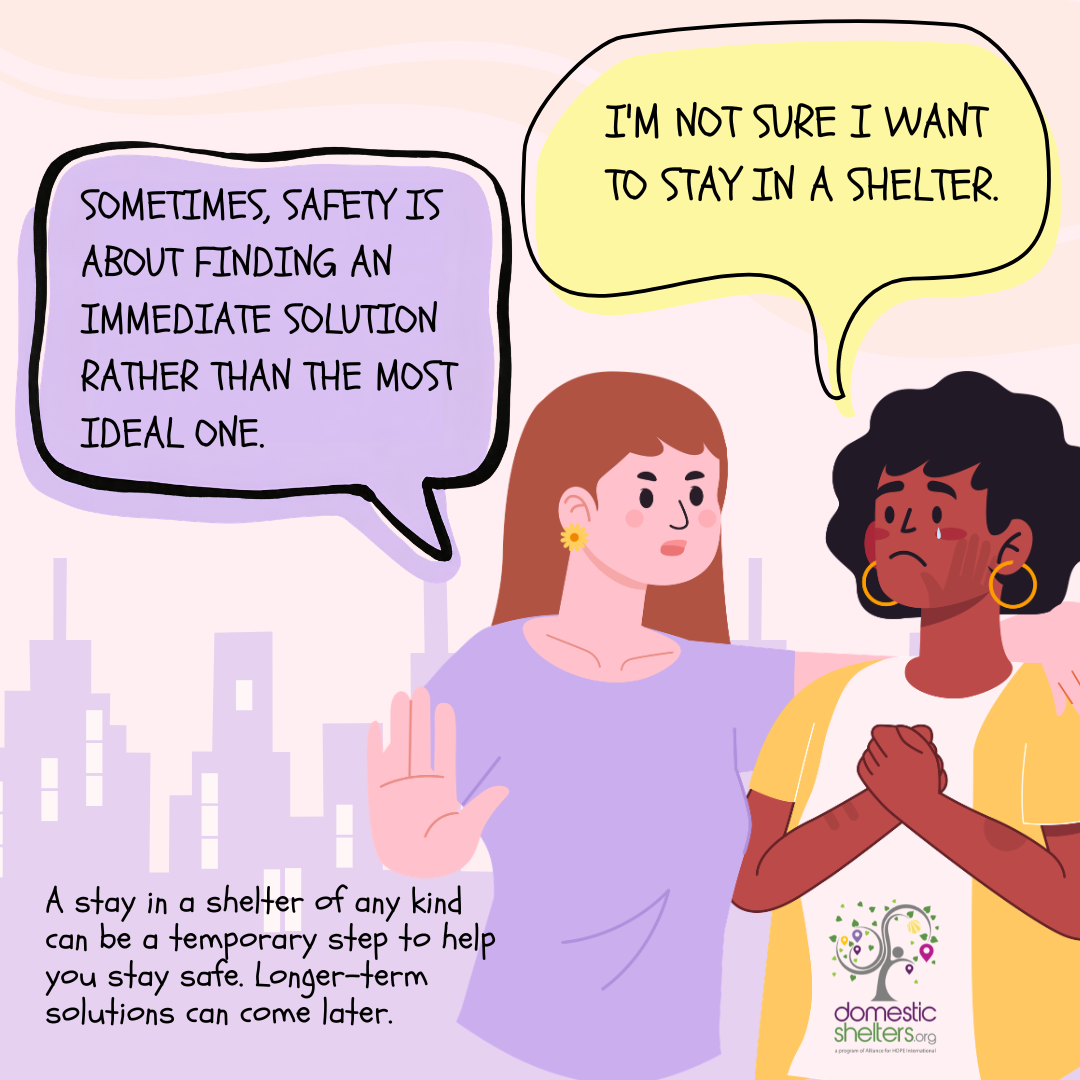
Sometimes, safety is about finding an immediate solution rather than the most ideal one. A stay in a shelter of any kind can be a temporary step to help you stay safe. Focusing on reducing risk, creating distance from the abuser and connecting with people or services that can support you right now is vital. Longer-term solutions can come later.
Connect with a domestic violence advocate with our Get Help page or through Hope Chat in the bottom corner of your screen to access more resources and support. Use https://www.findhelp.org/ to find other social services and resources like homeless shelters.

Welcome, this is your discreet connection to help.
You are safe here.
Menstruation is an experience shared by
generations of women across the globe.
Sadly, abuse is another commonly shared experience between women.
Be it physical or psychological, abuse is not OK in any form.
Period.
You are not alone.
Help is just a few clicks away.
Welcome to DomesticShelters.org, a trusted Bright Sky US partner. On DomesticShelters.org, you will find free domestic violence resources such as:
The Bright Sky US website is still open on your browser in a separate tab, so you can return to the Bright Sky US website anytime.