1. Select a discrete app icon.








notes

This story was originally published in 2021. It was updated in 2026.
The “grey rock” method is a communication tactic that people use to deal with toxic, manipulative, and/or abusive behavior. It involves being emotionally unreactive to avoid escalation and to disengage from abusers.
At first glance, this method can feel mean or even immature. After all, isn’t shutting down emotionally just another version of the silent treatment? Isn’t refusing to engage a form of punishment? Those questions matter because intent matters. And when a partner is abusive, silence doesn’t always mean control—sometimes it means escape.
In this article, you’ll learn how and when to apply the grey rock method as well as the considerations to keep in mind to ensure your safety.
Think of a rock in a river. The water rushes, churns, and throws itself against the rock—demanding movement, resistance, reaction. The rock doesn’t respond. It doesn’t explain itself. It doesn’t push back. It just is. And eventually, the current moves on.
That is essentially the grey rock method. You’re avoiding your partner through passive protest—you won’t engage, react or rage right back at them. In some cases (but certainly not all cases), this is an effective way of avoiding escalation when your partner is abusive.
Domestic abuse survivors often have to withstand partners who use verbal and emotional abuse to try to elicit a response. They want to see their words have an effect. When survivors ‘fight back’ in any form (verbally or physically) the abuser can weaponize that reaction and make the survivor out to be the abusive one.
This isn’t just a cruel form of psychological manipulation; it can also have real-world consequences, especially when police are called to the scene. Often called DARVO (deny, attack, reverse victim and offender) abusers use this technique to make themselves appear to be the victim. It can even result in the survivor being arrested instead of the abuser.
When a survivor feels pushed into a corner (e.g., the abuser relentlessly tries to get a rise out of their partner to torture/punish them in some way), the best option is always to escape before things turn dangerous.
However, there are times when that’s not a possibility. For example, when:
In situations like these, the grey rock method may help keep you safe from further escalation.
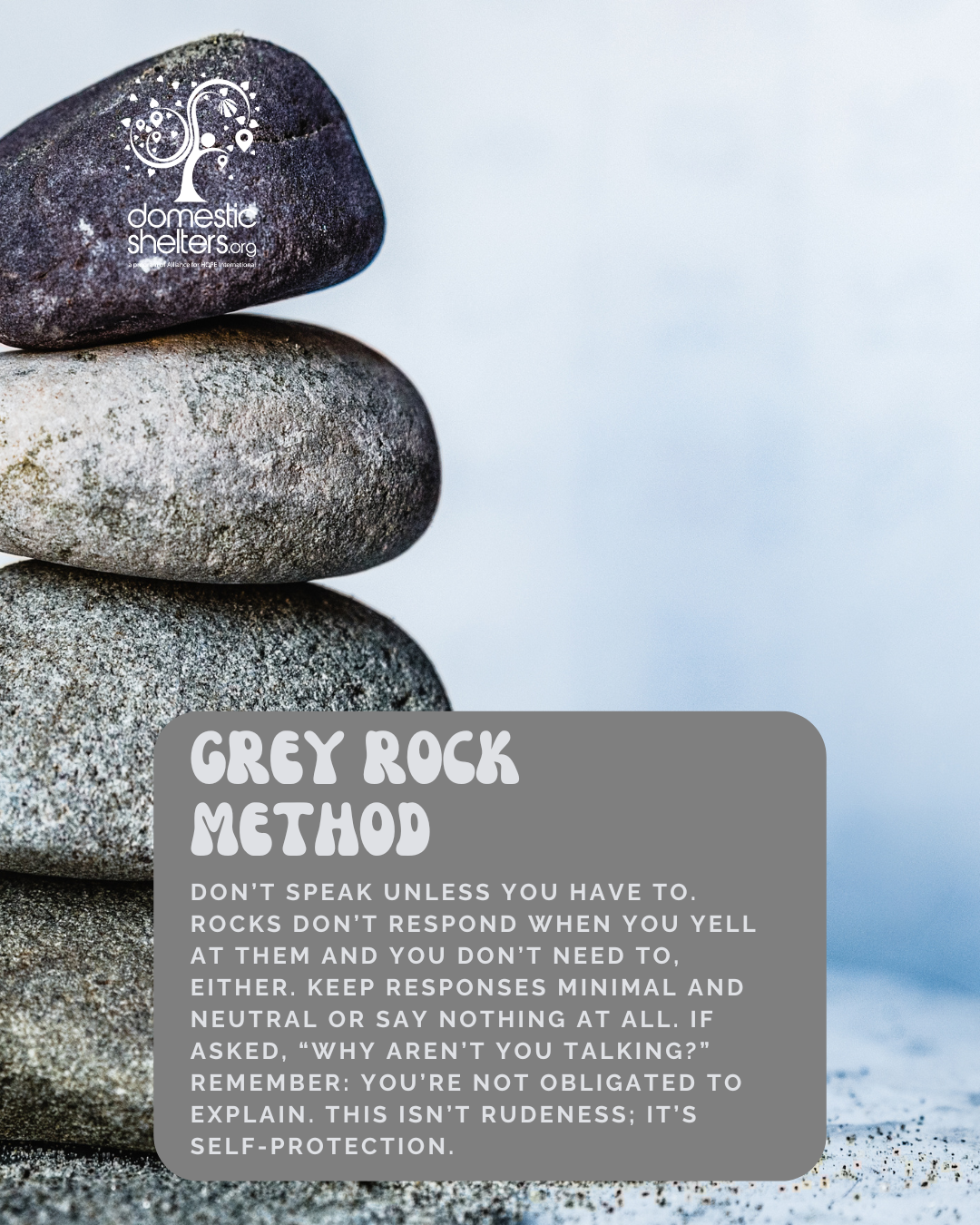
When using the grey rock method during an abusive incident, consider the following:
When abusive partners reach out, they often attempt to either harass and berate you for your choice, to threaten you if you don’t change your mind or to try to woo you back with supposed kindness or romance. This is another instance of when the grey rock method may be appropriate, as a non-response is often the best response.
For survivors who share children with an abuser and are forced to continue interacting with that ex, flat, emotionless and calm responses to the abuser’s provocation attempts will likely be the best way to shut that down.
For more information, read, “Ask Amanda: How Do I Co-Parent With an Abuser?”
Yes, there can be risks when using the grey rock method. In particular, the abuser may escalate when they don’t get a response from you.
“This is especially the case if this is a new or unexpected response from the survivor,” says Karina Barreto, licensed professional counselor with Blue Tansy, a trauma therapy practice based in San Francisco. “Some abusers try to get a reaction and give up when they don’t get it. That said, it would be a short-term fix to prevent escalations.”
Instead, it’s recommended to use the grey rock method alongside outside support, along with a personalized safety plan. You can find support by calling a domestic violence advocate at your local nonprofit—find yours through our Help page or by using the Hope Chat that pops up when you first visit this site.
Barreto says some survivors may find themselves becoming grey rocks naturally in triggering situations, similar to the ‘freeze’ response—one of the four responses (alongside ‘fight,’ ‘flight,’ and ‘fawn,’) that many people have in traumatic situations. In any of these cases, our sympathetic nervous systems take over, directing our brains to release chemicals to address the threat. When ‘freezing,’ not only can a person feel frozen and unable to react (even if they wanted to), but they may also experience fragmented or incomplete memories of that moment.
Looking ahead, you should consider how to extricate yourself from a person who causes you to turn into stone for self-protection. After all, this is not a sign of a healthy relationship.
It might help to first talk to a domestic violence advocate near you for support, as we mentioned earlier. They can help you with safety planning, emotional support and plans for the future—including emergency shelter, transitional housing or other types of relocation assistance if you share a home with the abuser.
You may want to read, “Breaking Your Lease Without Breaking the Bank” if you’re sharing a lease with your partner. And then you may want to start thinking about how you can become financially independent if you aren’t already. (Most abusers utilize financial abuse to make it even harder for a survivor to leave them.)
Here are some relevant articles that may help:
Remember, even though a narcissistic abuser will try to convince you what’s going wrong is your fault, it’s not your fault. No one deserves to be abused. Your partner should not make you feel afraid, degraded or ashamed. And if you’re turning yourself into a rock to deal with a partner, it’s definitely time to consider getting out.
Your support gives hope and help to victims of domestic violence every day.

Welcome, this is your discreet connection to help.
You are safe here.
Menstruation is an experience shared by
generations of women across the globe.
Sadly, abuse is another commonly shared experience between women.
Be it physical or psychological, abuse is not OK in any form.
Period.
You are not alone.
Help is just a few clicks away.
Welcome to DomesticShelters.org, a trusted Bright Sky US partner. On DomesticShelters.org, you will find free domestic violence resources such as:
The Bright Sky US website is still open on your browser in a separate tab, so you can return to the Bright Sky US website anytime.


