1. Select a discrete app icon.








notes

This piece was originally published in 2015. It was updated in 2026.
It’s a polarizing question with no clear-cut answer. Can an abuser change? Granted, it depends on what we’re asking them to change. Their clothes? Most likely they can handle that. Their ingrained belief that they’re entitled to have power and control over their partner and inflict various punishments if their partner disobeys? That one’s a bit trickier to call.
Since sometime in the ‘90s, domestic violence advocates have been attempting to reform abusers through multi-week educational programs focusing on taking accountability for one’s actions. Before batterer intervention programs (BIPs) came along, the somewhat common belief was that abusers had little to no control over their behavior, that it was caused by mental illness, alcoholism, spending time in combat or because their parents beat them as children. Over time, each one of these excuses has been proved to be just that—an excuse, not a cause. While they may increase the risk an individual will use abusive tactics with a partner, sobering up an abuser will only result in, well, a sober abuser. Add to that the fact that most people with the aforementioned challenges do not abuse their partners.
So, what is it that changes an abuser? Can you love someone out of choosing abuse? While some survivors may hope that is true, and while an abuser does have a period of not abusing that can feel like change, unfortunately, it’s likely not to be long-term. But it also won’t stop someone who relies on emotional manipulation to ask a survivor for just one more chance over and over and over again.
Domestic violence expert and former attorney and instructor in a batterer reform program for over two decades, Barry Goldstein, says the only way domestic violence incidents can decrease is when abusers are held accountable and are consistently monitored. But he stops short of saying that an abuser will be completely reformed, never to utter a controlling word to a partner again.
The majority of abusers who end up in a BIP to hold them accountable are done so by court order following an arrest for domestic violence. The BIP is typically an alternative to jail time, and most abusers eagerly choose that option. However, advocates warn that most domestic violence offenses happen behind closed doors, never to be reported to law enforcement. That means that unless an abuser voluntarily enrolls in a BIP—which constitutes a very small percentage of participants—many will never know accountability.
Proving the efficacy of BIPs is difficult. While statistics show that male batterers who complete a BIP have a low arrest rate for domestic violence in the two years following the program compared to those abusers who didn’t complete the program, we also know that abuse often is often perpetrated in secret.
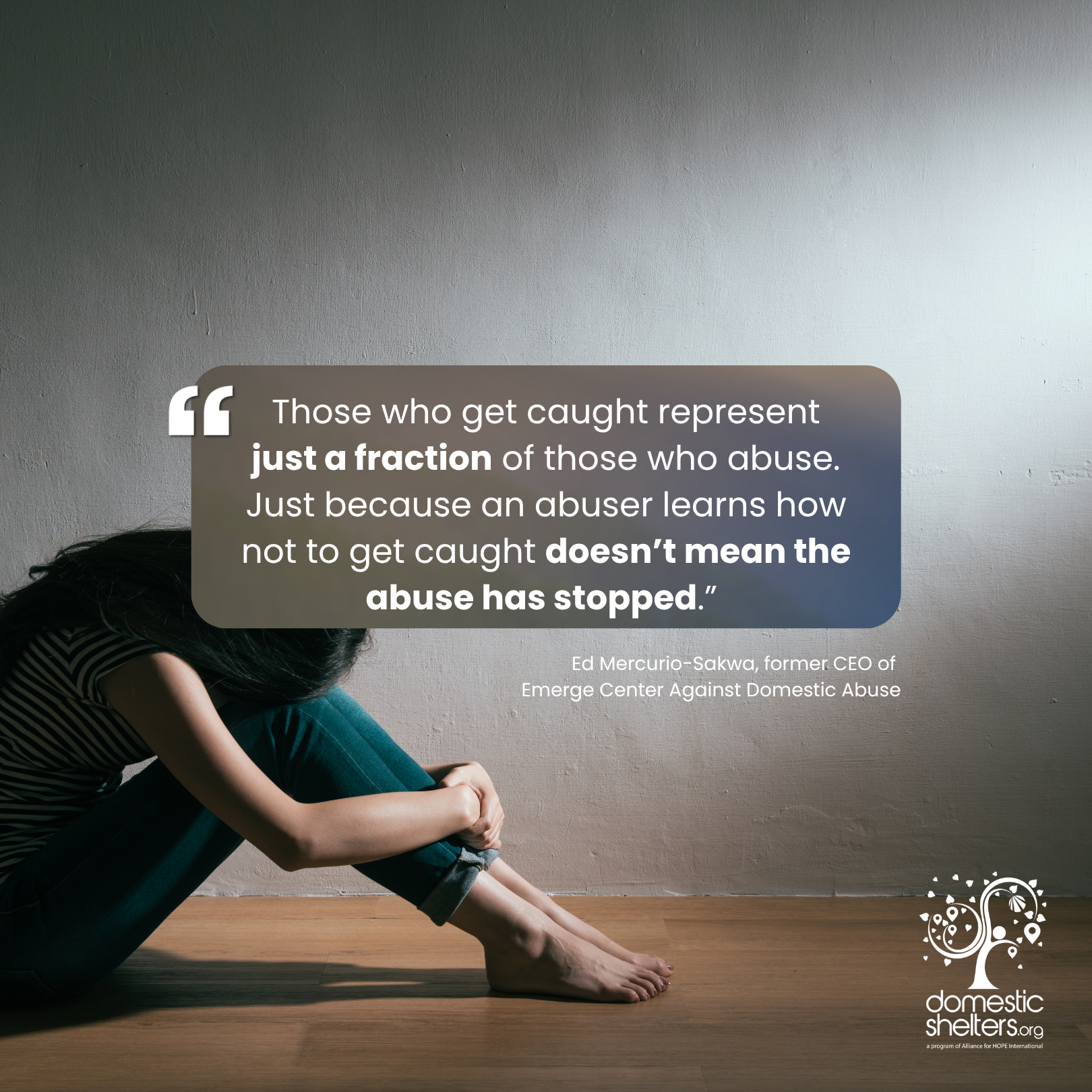
Recidivism—or, whether the offender gets arrested again for abuse—is the traditional way to judge the effectiveness of a reform program, but Ed Mercurio-Sakwa, former CEO of Emerge Center Against Domestic Abuse in Tucson, Ariz., calls this a false dynamic. “Those who get caught represent just a fraction of those who abuse. Just because an abuser learns how not to get caught doesn’t mean the abuse has stopped.”
Instead, he says the BIP at Emerge relies mainly on victim contact. “We reach out to the victims of every participant. It’s totally voluntary and confidential. If they’re interested, we keep up ongoing communication to see if there are changes in behaviors at home. That’s really our greatest measure of success.”
Of course, we also know many women are afraid to answer honestly, often closely monitored by a partner who still intimidates them, even if the physical abuse has stopped.
Couples counseling can be a solution for nontoxic partners to work through relationship challenges, but experts warn it’s a no-go when abuse is present. With domestic violence, the issue isn't a lack of communication or mutual conflict; it's one partner's pattern of power and control over the other.
“I think couple’s counseling is dangerous [in domestic violence situations],” says Kevin Nowlan, chief operating officer of the Center for Prevention of Abuse. “In an unhealthy relationship, an honest interaction can’t take place. If survivors are honest, that means violence will likely be perpetrated against them.”
Experts also warn that abusive partners often manipulate the therapist, just as they do to their partner. They may minimize or deny abusive behavior, portray themselves as the victim or use information shared during counseling sessions to further control or retaliate against their partner afterward.
Therapy in the traditional sense likely isn’t going to be a solution to ending someone’s need for power and control.
Nowlan believes domestic violence is a learned behavior, and therefore, believes it can be unlearned.
“No one is born abusive,” he says. “It’s polarizing, but I one-hundred-percent think people can change.” He says BIPs like the one at the Center are likely the best therapeutic solution to make a tangible difference in abusers’ patterns.
“They learn how to be healthy in a current or future relationship within an intensive 26-week group, two-and-a-half hours per group once per week,” says Nowlan. He says other advocates believe all resources should be allocated to survivors, not perpetrators. But to Nowlan, this is counterproductive. Even if an abuser gets arrested, he says, “when that partner gets out, they’re going to go on to abuse another partner.”
A survivor should always trust their gut instinct if they feel like a partner is still using abusive or manipulative tactics. The tricky thing is that those abusive tactics can feel familiar the second or third time around, even though they’re unhealthy and unsafe. A survivor might feel lulled back into a pattern of abuse, apology and reconciliation, still holding out hope that the abuse will stop.
Sometimes abuse doesn't disappear but rather, it changes shape. A partner who no longer yells or uses physical violence may still monitor a survivor's phone, isolate them from loved ones, coerce them into sex, control finances or use guilt, intimidation or threats to maintain power.
Survivors don't have to wait for another incident of abuse to decide a relationship isn't healthy. Feeling consistently anxious is a very valid reason to prioritize safety.
Even if an abuser makes promises of change, completes a BIP, gets sober, makes apologies and has remained abuse-free for a period of time, it’s not a guarantee that their abuse has stopped. Nowlan says to look for these signs of change—not just one, but all—before trusting an abuser again.
Are you dealing with a narcissist? Learn why they will never change in "A Narcissistic Abuser Will Never Change."
If you're wondering whether an abusive person in your life has truly changed, you don't have to figure it out alone. Use our Get Help tool or click Hope Chat in the corner of your screen to connect with an advocate who can help you talk through your situation.
Your support gives hope and help to victims of domestic violence every day.

Welcome, this is your discreet connection to help.
You are safe here.
Menstruation is an experience shared by
generations of women across the globe.
Sadly, abuse is another commonly shared experience between women.
Be it physical or psychological, abuse is not OK in any form.
Period.
You are not alone.
Help is just a few clicks away.
Welcome to DomesticShelters.org, a trusted Bright Sky US partner. On DomesticShelters.org, you will find free domestic violence resources such as:
The Bright Sky US website is still open on your browser in a separate tab, so you can return to the Bright Sky US website anytime.


