1. Select a discrete app icon.








notes

This story was originally published in 2021. It was updated in 2026.
Many survivors of intimate partner abuse say that the first time they saw the Power and Control Wheel, what they were experiencing finally made sense. The diagram, used by advocates, psychologists, educators and healthcare professionals, outlines the tactics abusers use to gain and maintain dominance.
What once felt uniquely personal begins to look disturbingly familiar. Survivors who believed they were alone in enduring certain behaviors come to understand that those behaviors are deliberate strategies. Abusers create a sense of isolation by minimizing their harm, reframing it as a one-time incident, or promising it will never happen again. The Wheel illustrates how those moments are not misunderstandings, but rather components of a larger system built around control.
Instead of centering on singular episodes of physical violence, the Power and Control Wheel maps the surrounding tactics — intimidation, economic abuse, coercion, gaslighting, isolation — that construct the abuser’s violence. Physical harm may be the most visible spoke, but power and control are the hub.
Because there is no single profile of an abuser, the Wheel has evolved over time. Experts have developed versions tailored to LGBTQ+ relationships, immigrant communities, teen dating violence and other contexts. The abuser’s tactics may shift depending on circumstance, but their objective remains constant. Finding the version that mirrors your experience can be more than validating — it can be enlightening. And this enlightenment can lead a survivor to safety.
The Wheel is a visual tool with power and control in its center and eight spokes surrounding it, each outlining tactics abusers are likely to utilize. Some survivors are subjected to just one or two of these methods of control and some recognize all of them as part of their partner’s behavior.
As the illustration shows, the center of domestic violence is always rooted in power and control. Abusers are not simply partners with anger management issues. They don’t “fly off the handle” or lose control of their emotions. Quite the opposite, warn advocates. Abusers are often calculated, planning far in advance their tactics of power and control over a partner.
By knowing what to expect from an abuser, a survivor may more easily come to accept that there is nothing they’re doing to cause their partner’s abuse. Abuse is never a survivor’s fault, and always a choice the abuser is making.
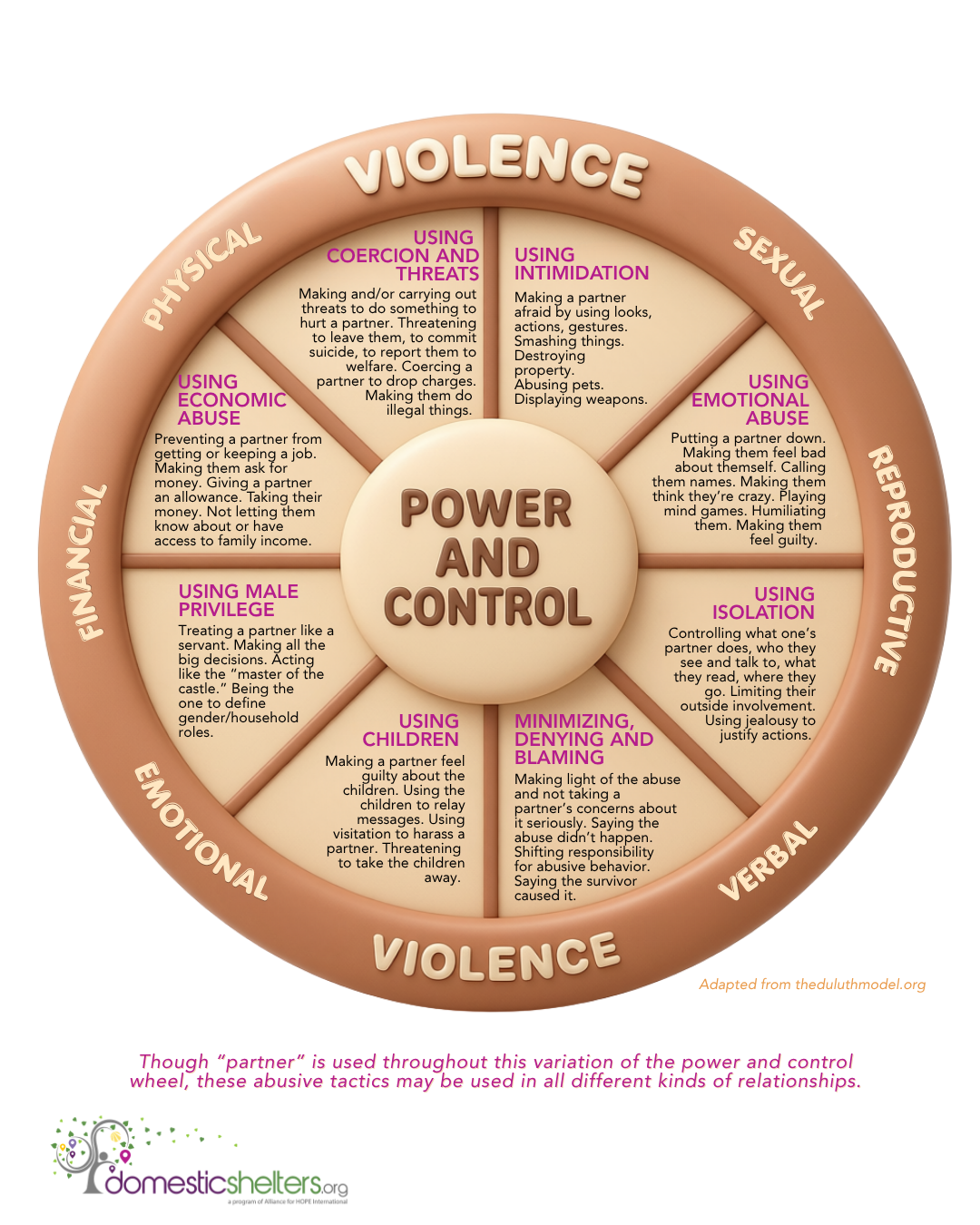
The Power and Control Wheel was created by the Domestic Abuse Intervention Project (DAIP) in 1984 to both help victims of domestic violence and to educate abusers. Through focus groups with survivors, they developed a wheel outlining the most common tactics of abusive partners. In contrast with the Cycle of Violence, the Wheel doesn’t imply these experiences happen in a certain order, but rather, in combination, denote a pattern of power and control, the two facets that hold the wheel together at its center.
The original Power and Control Wheel (there are many variations of the Wheel that we talk about a little later in this article) is divided into eight sections. These sections outline how an abuser gains and maintains power and control over a partner.
Abusers use threats of violence and psychological manipulation to force a survivor to do something they don’t want to do. This can range from controlling where a survivor goes and what they wear, to who they see or talk to. It can involve coercing the survivor to do something illegal or to drop charges against the abuser. Studies have found that in 80 percent of domestic violence cases that reach the court system, survivors have recanted or refused prosecution, often because of the manipulation of their abusive partners from behind bars.
Abusers don’t always need to use physical violence to control their partners. An intimidating stare can often be enough to control a survivor who knows what will come next if they don’t comply with the abuser. Abusers may also destroy things, punch holes in walls, or harm pets to scare their partners. An abuser may obtain a weapon and leave it out in the open as a silent threat to the survivor of what’s to come.
Emotional abuse is when an abuser manipulates a partner’s feelings to control them. They can do this by lying, gaslighting or bullying their partner. They may tear down a partner’s self-esteem through degrading comments and name-calling. A survivor may begin to believe they don’t deserve any better, or that they’re to blame for the abuse they’re enduring.
Isolating a survivor from the people who could offer support — friends, family members, coworkers, teachers, or medical and mental health professionals — makes it far less likely they’ll hear any perspective other than the abuser’s. Without outside voices, their experiences go unvalidated, and the cycle of manipulation deepens. They may begin to believe the abuse isn’t really that bad, or worse, that they are somehow to blame for it.
DARVO (Deny, Attack, Reverse Victim and Offender) is a common way abusers minimize, deny and blame the survivor for the abuse. It’s a way in which abusers change the narrative—to the survivor, to friends and family, even to police—and make themselves out to be the victim while the survivor is painted as the perpetrator.
One of the most spiteful ways in which abusers gain and maintain control over their victims is by using their shared children as pawns. Abusers will threaten to take away the children if the survivor tries to leave or tells anyone about the abuse. Or they will weaponize family court through something called legal abuse. They may also use custody exchanges as a way to continue to torture the survivor after separation.
Men who abuse their partners often share a belief in rigid, traditional gender roles. They see themselves as the head of the household and expect their wives to be submissive. Abuse may be framed as simply “setting the rules” of the home, masking the reality of what it is: an effort to maintain power and control.
Also called financial abuse, this tactic of control involves an abuser restricting their partner from earning or accessing money. The abuser may frame it as taking care of the survivor—“Don’t worry about getting a job; I’ll pay the bills”—when, in actuality, they are keeping the survivor trapped through dependence. It can also look like ruining a survivor’s credit, stealing her money or forcing her to work without pay for a family business.
After creating the Power and Control Wheel, DAIP determined it would also be useful to have a wheel that illustrated the facets of what a healthy and safe relationship looked like.
“The team listened to women in support groups saying they knew one type of relationship but didn’t know an alternative. They wanted an example to be able to look for in their lives,” says Melissa Scaia, former executive director of DAIP.
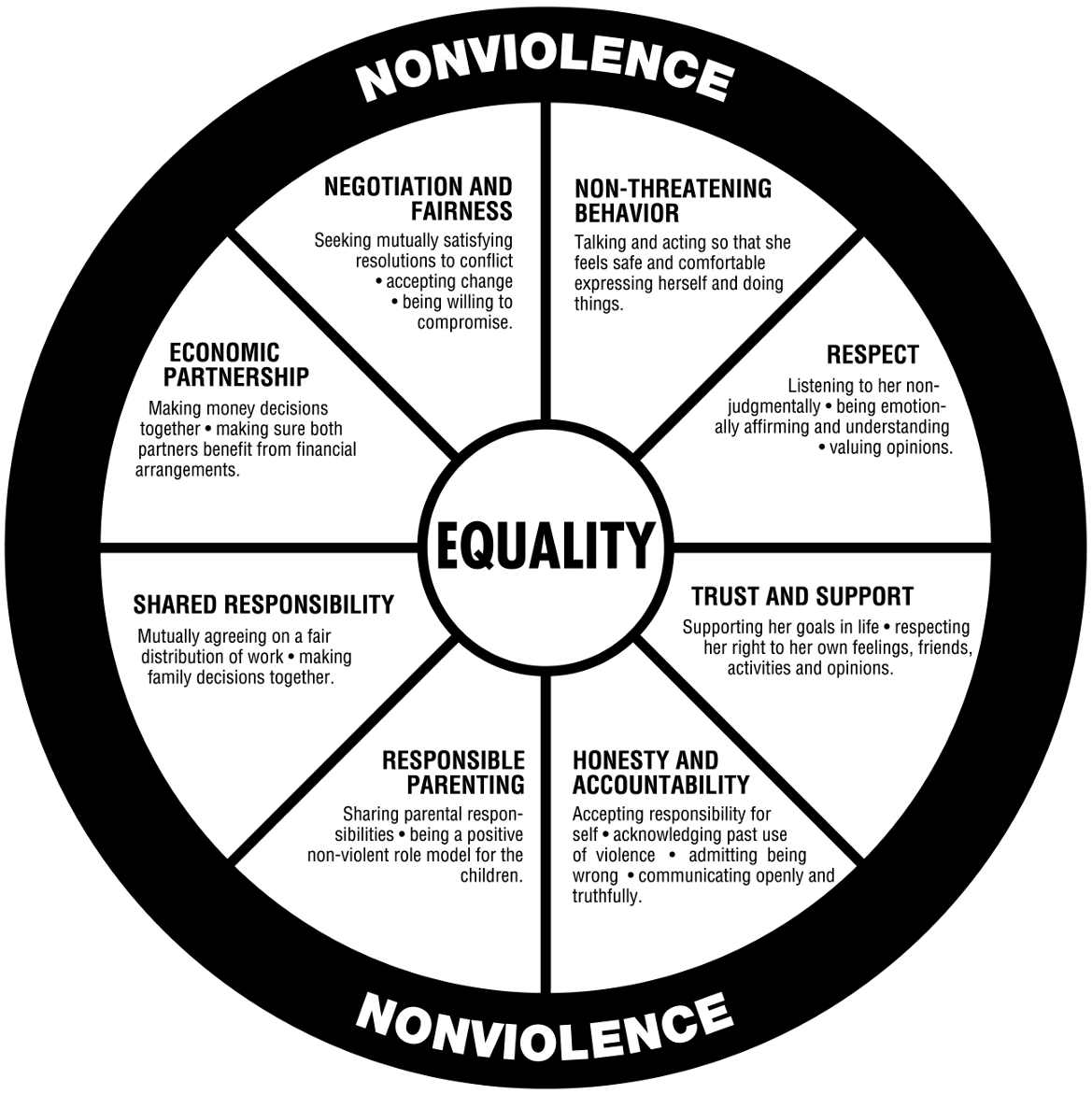
The Equality Wheel includes characteristics of a safe relationship, such as trust and support, honesty, shared responsibility and respect.
“If you lay the equality wheel over the Power and Control Wheel, you’ll see they are corresponding opposites,” Scaia says. “So, for instance, instead of emotional abuse, you’ll see respect.”
Because abuse can take so many forms, at least 40 additional Power and Control Wheels and similar visual aids were created. The Wheel is also available in myriad other languages, from Swahili to Urdu.
Here are some of the examples of other wheels available for different sects of abuse survivors:
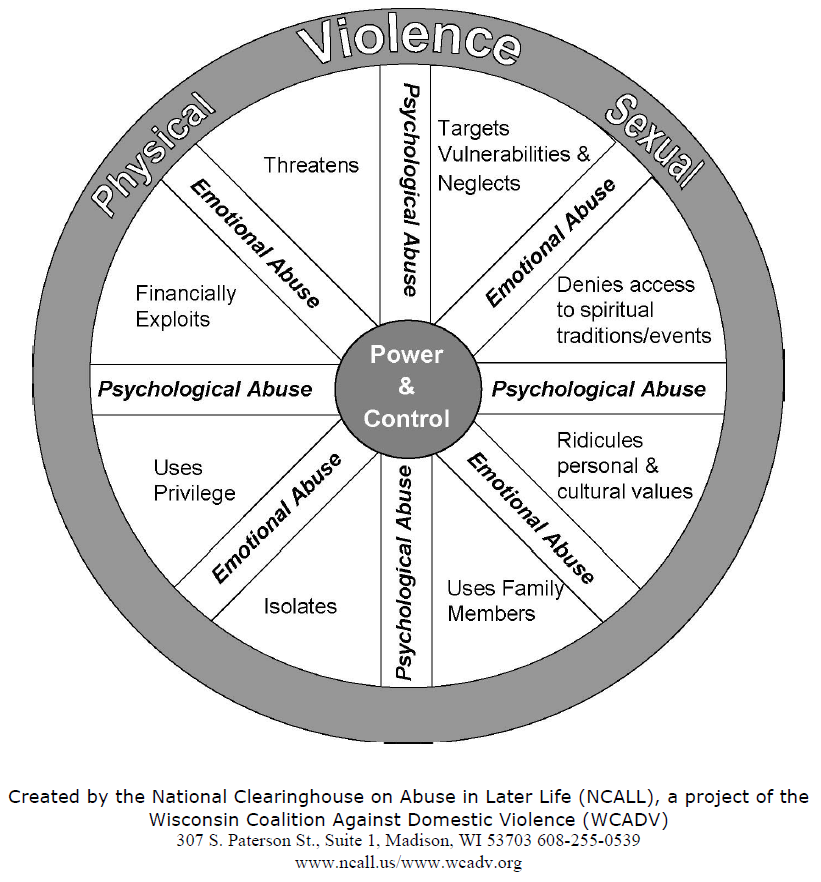
The Abuse Later in Life Wheel outlines how abusers may target elderly victims of domestic violence with slightly different tactics, such as financial exploitation, neglect and using family members against them.
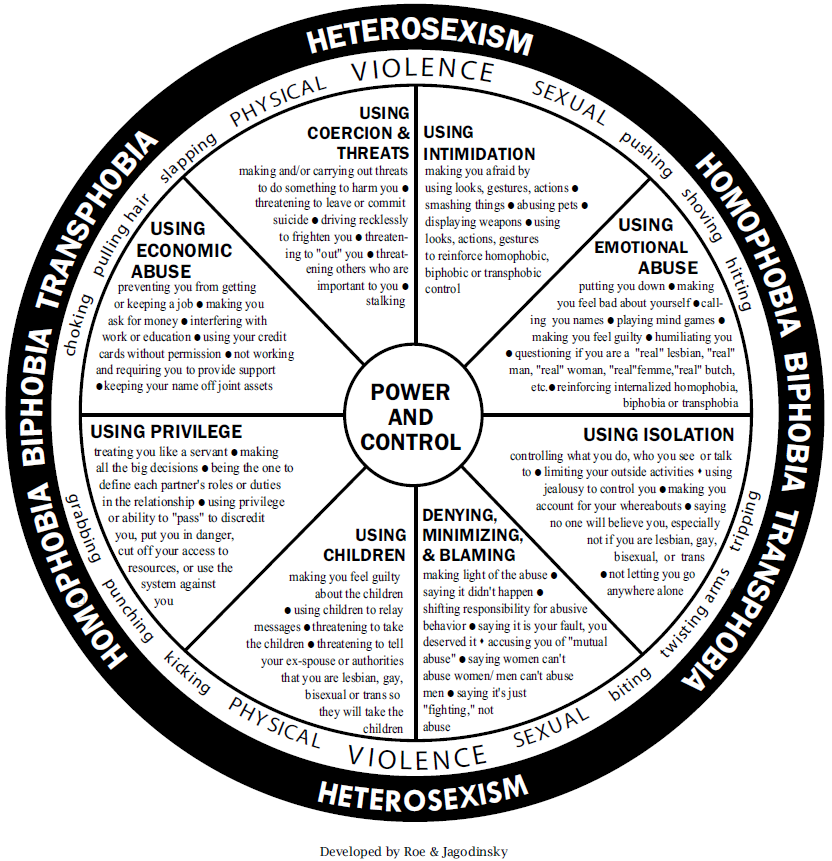
The Gay, Lesbian Bisexual and Trans Power and Control Wheel specifies tactics abusers can use that specifically apply to those who identify as LGBTQ+, including threatening to “out” the survivor, keeping the survivor’s name off joint assets or asserting that it can’t be abuse because women can’t abuse women, or men can’t abuse men.
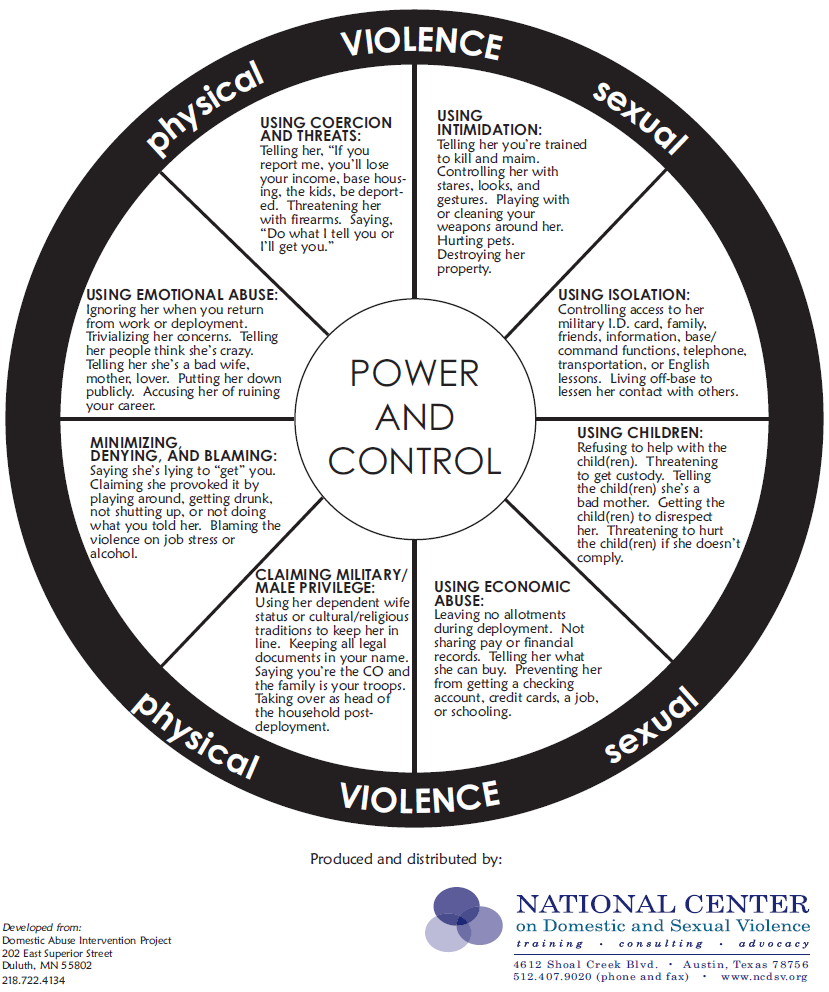
The Military Power and Control Wheel focuses specifically on the experiences a military spouse may have with an abusive partner. Facets like restricting money from the survivor when deployed, or controlling access to her military ID—necessary to obtain basic needs—are included.
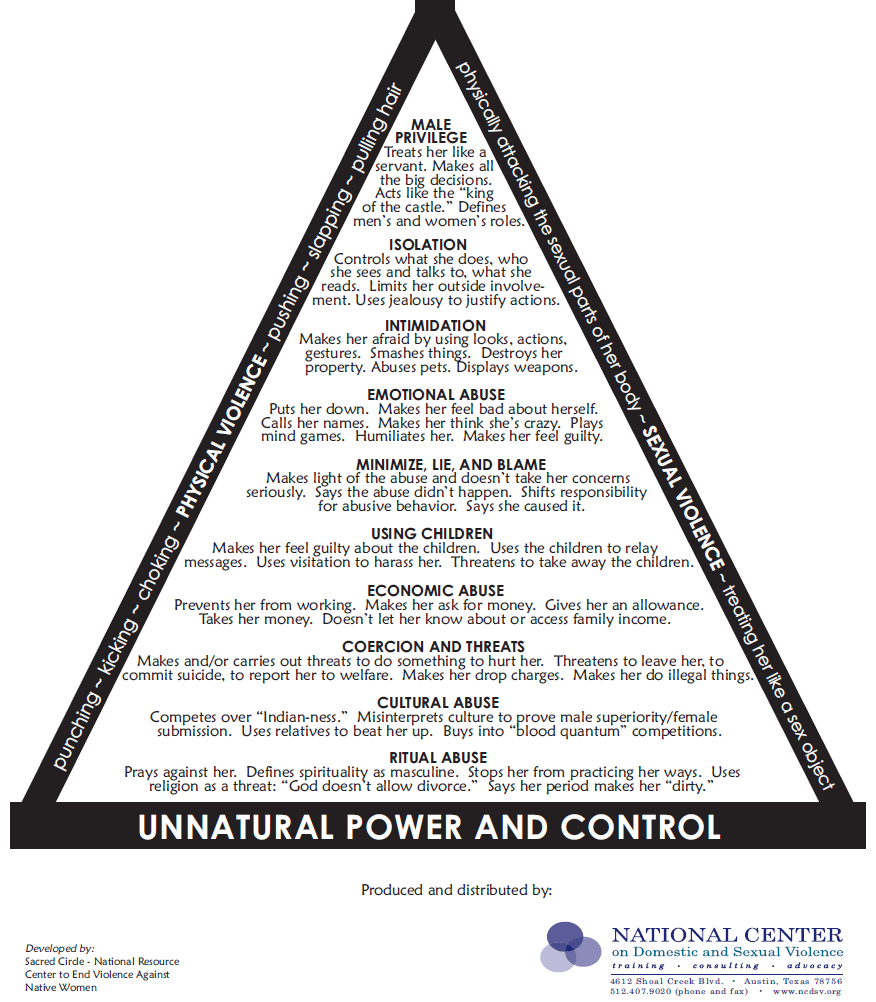
The Violence Against Native Women diagram is a triangle illustration that outlines components of cultural and ritual abuse, as well as the other tactics abusers use with non-native victims.
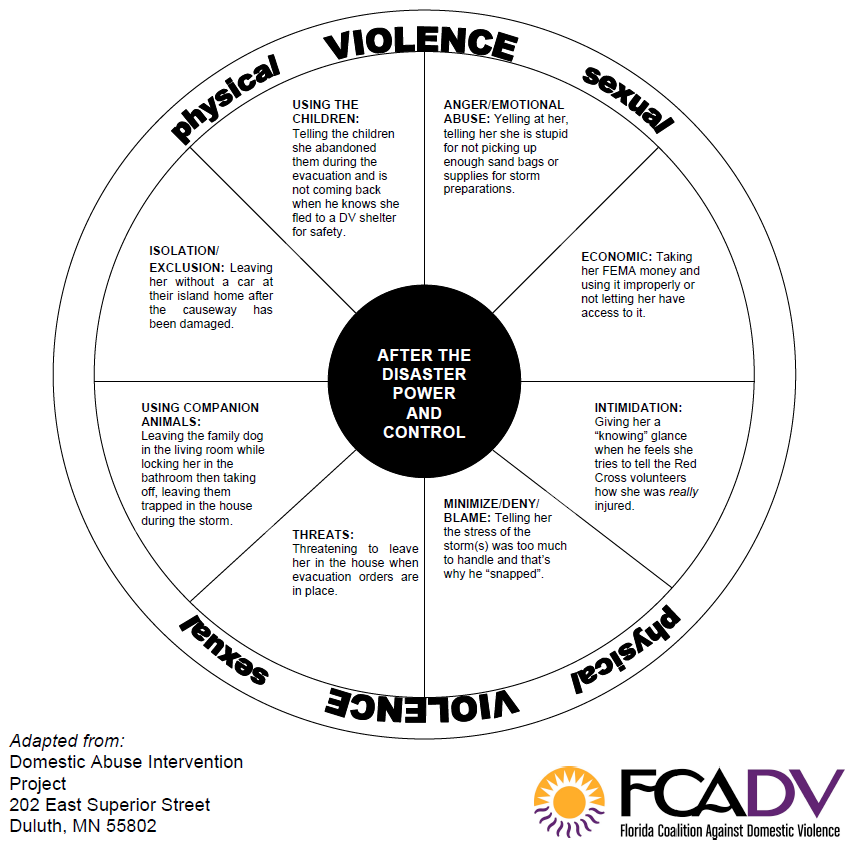
The Natural Disasters Power and Control Wheel includes information about how abuse can show up during and after natural disasters. Abusers may blame the stress of the disaster for their abuse or may threaten to leave the survivor, children or pets when evacuation orders are given.
The Power and Control Wheel has been shared worldwide because it clearly illustrates one simple point: abusers aren’t random. They follow patterns. For some survivors, seeing those patterns on paper is the moment things begin to shift. It’s the moment they realize what’s happening has a name—and that they’re not alone.
To find support in understanding abuse and getting to safety, visit our Get Help page to locate a domestic violence organization near you with advocates ready to listen. Or use Hope Chat, our AI assistant located at the bottom of your screen. Hope Chat can help lead you to articles on our site that explain abusive tactics and safety solutions in more detail.

Welcome, this is your discreet connection to help.
You are safe here.
Menstruation is an experience shared by
generations of women across the globe.
Sadly, abuse is another commonly shared experience between women.
Be it physical or psychological, abuse is not OK in any form.
Period.
You are not alone.
Help is just a few clicks away.
Welcome to DomesticShelters.org, a trusted Bright Sky US partner. On DomesticShelters.org, you will find free domestic violence resources such as:
The Bright Sky US website is still open on your browser in a separate tab, so you can return to the Bright Sky US website anytime.


