1. Select a discrete app icon.








notes

This article was last published in 2022. It was updated in 2026.
For many survivors, abusers follow a devastatingly predictable pattern that, over time, feels like quicksand. Advocates emphasize that abusers are not necessarily impulsive or out of control, but rather rigidly in control. Most carefully plan and calculate their abuse, whether it’s subtle forms of control or threatening acts of violence. As the phases repeat themselves, a survivor may struggle to escape while, gradually at first, sinking into increasingly more danger.
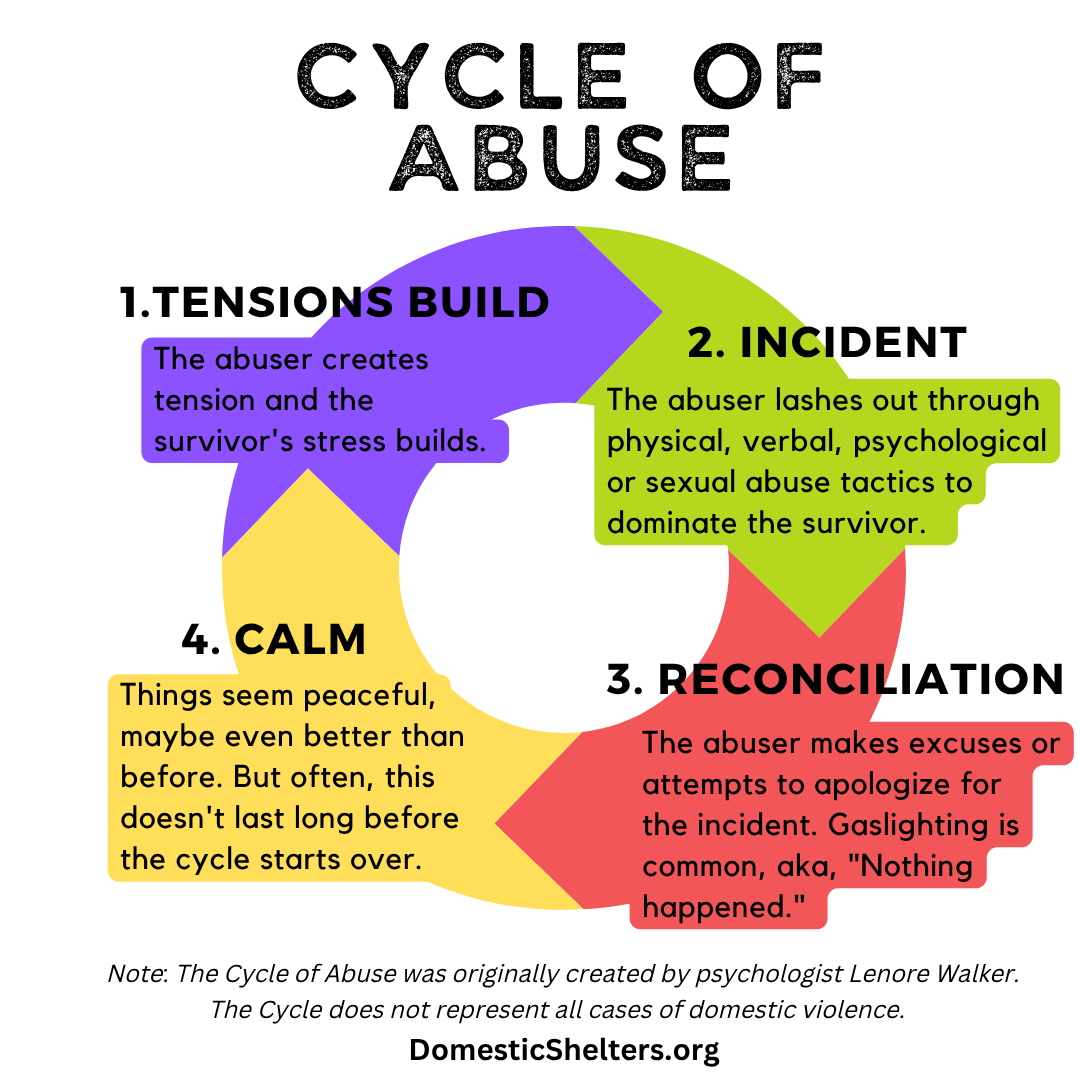
The Cycle of Abuse was first introduced in 1979, but since then some advocates argue that the tool isn't all-encompassing, instead referring to a more recent visual aid called The Power and Control Wheel as a better depiction of abuse. Still, the cycle continues to resonate with many survivors and its overall message is clear—domestic violence is destructive, ongoing and relentless.
The cycle of abuse suggests that there are four phases of abusive behavior:
The cycle begins with tension building, creating fear in the victim. This tension might come from stress related to everyday events like work, family conflict or financial problems. It could also come from bigger events like illness and catastrophic events. It’s important to note that most people can cope with stressors like these without taking it out on others—the abuser is just using these events as an excuse to justify their actions.
Victims might try to placate the abuser and avoid the next phase of violence by becoming submissive or extra helpful. Some survivors may intentionally confront the abuser or take an action they believe will trigger the anticipated incident sooner. This can be a survival strategy intended to create some sense of predictability or control over when or where the abuse occurs.
Next, there is an incident. This may be the abuser lashing out with physical, verbal, emotional or psychological abuse such as hitting, slapping, strangling, belittling, name-calling, screaming or yelling and intimidation.
While the entire Cycle of Abuse is a method abusers use to exert power and control over their victim, the incident phase is often a particularly frightening and dangerous time of the abuser trying to dominate the victim.
The third phase of the Cycle of Abuse is the “reconciliation” phase, though it could also be called “the excuse stage.” During this phase, the abuser might apologize for their behavior, try to excuse it (“I’m just stressed because of work.”) or blame it on the victim and falsely put the impetus on the victim to avoid it happening again (“Maybe if you don’t make me so angry.”)
Gaslighting is common during this phase, as the abuser denies that anything happened or claims that the incident wasn’t abuse.
Finally, there seems to be a period of calmness. The prior incident has passed and, for a while, things might seem somewhat normal, or even better than before. Survivors sometimes refer to this as "the honeymoon stage." An abuser might use love bombing to “make up for” the abuse—giving gifts, planning a romantic date, being more attentive—though this further manipulation is actually designed to keep the survivor from leaving the abuser.
Sadly, the calmness of this phase doesn’t last. Eventually, tension begins to build again. The abuser’s apologies and promises become insincere or vanish entirely. Before long, the abuser chooses another abusive tactic to utilize.
No, not every survivor will recognize a repeated cycle within their relationship with an abusive partner. For some survivors, there is no tension that builds. One moment, things are seemingly calm and the next, the abuser is verbally, physically or sexually attacking their partner. These survivors will say the abuse “came out of nowhere,” and they’re not wrong. While often controlled, abusers can also be unpredictable.
For others, there is no reconciliation, no “honeymoon phase.” A survivor may always feel fear when in their own home with the abuser. They may fully believe their partner will never change, but stay because they’re trapped by fear.
The main similarity of all abusers is the repeated incidents of power and control, whether that’s through physical or nonphysical tactics.
To learn the difference between healthy arguments and behaviors that point to power and control by one partner, read “It’s OK to Argue.”
We wish we could report that the cycle of abuse lessens over time and eventually the abuser decides it’d be better to not abuse, but unfortunately, the opposite has proven to be true. The time between abusive incidents may become shorter over time, bringing abusive incidents closer and closer together. The “reconciliation” and “calm” stages can disappear completely, leaving only tension that builds quickly into violence.
Many survivors are either too ashamed or too fearful to leave their abusive partner, convinced that they've now let it go on too long or that it was their fault the abuse started in the first place. This, of course, isn’t true—instead, victims are caught in a carefully designed and planned cycle made to trap them under the power and control of their abuser.
Besides fear, shame and a host of other barriers to leaving (there are at least 50, says Sarah Buel, JD, retired clinical professor of law at Arizona State University), survivors may be convinced they are in love with the partner who also threatens them with violence, or outright hurts them.
“Survivors feel like [the abuser] is a person they can change. This is not love—it’s trauma bonding,” says Yvette Lozano, Chief Program and Operations Officer with the nonprofit Peace Over Violence.
Trauma bonding is a powerful psychological bond that survivors can feel toward someone who is abusing them. Intermixed are feelings of sympathy, concern and self-blame—if I was just better, they wouldn’t be abusive. The abuser may have shared that they, too, were abused in the past, usually by a parent or caregiver. They use this as an excuse for their own abusive choices. The survivor on the receiving end of their abusive tactics is confused—they’re not safe, but is it really the abuser’s fault?
Trauma bonding is different from shared trauma in which two people feel a deep connection after going through something traumatic together. Trauma bonding involves an abuser manipulating their partner, brainwashing them into feeling sorry for them. This may also be referred to as Stockholm Syndrome, originally used to describe victims who felt compassion toward their captor. But it can also describe the nurturing inclination a victim has toward their abusive partner that keeps them trapped, feeling responsible for “fixing” their abusive partner.
To learn more, read “When Survivors Believe They’re Responsible for Ending Abuse.”
Optimistically, yes, survivors can take steps toward safety and healing. However, that’s not always possible—every situation with an abusive partner is different. And the responsibility to end the abuse lies with the person choosing to abuse, not the victim. And it’s rare that a cycle of abuse will stop while staying in the relationship, no matter what the abuser may promise. Read “Can Abusers Change?” for more information.
However, survivors can break the cycle in their own way by leaving an abusive partner when they deem it safe and possible to do so, seeking legal accountability for their partner’s abuse and working on healing themselves and their children so that the cycle doesn’t continue into future relationships.
Of course, these things are not easy. Survivors shouldn’t feel like they have to go at it alone. Reach out to your nearest domestic violence advocacy organization or Family Justice Center to develop a safety plan before leaving and talk about emergency shelter. As survivor Anna Lee told DomesticShelters.org after escaping, “I don’t want to sugarcoat anything. It’s hard beyond description … but it’s absolutely worth it.”
Learn more about abuse by exploring the Identifying Abuse section on this site. If you’re worried that you’re trapped in the cycle of abuse, reach out to a domestic violence advocate near you to find local resources and support. Advocates can help you create a safety plan—a contingency plan for any possible scenario that should arise when you’re ready to leave. If something in your relationship feels wrong, unsafe or controlling, Hope Chat, located at the bottom of this page, can help you explore what you’re experiencing, learn more about patterns of abuse and find resources that may help. It’s anonymous, available 24/7 and designed to support you wherever you are in your journey.
What are the four stages of the cycle of abuse?
The four stages of the cycle of abuse are as follows:
Noticing a pattern emerge of an abuser’s behavior may indicate that a cycle of abuse is occuring. It may help to keep a log or a diary of what’s going on day-to-day so that the cycle can become clearer. Make sure to keep the log in a place where the abuser can’t find it—password-protected on a computer or handwritten but kept somewhere like your place of work or a friend’s house.
No, not every survivor will experience the above steps. Some abusers never try to reconcile. Some survivors will never experience calm. But many advocates and survivors of multiple abusers report that abusers do seem to follow a similar “script.” Abusers can be deceptive though, and many survivors end up doubting that what’s happening is abuse at all. Read, “10 Ways to Spot Deceptive Coercive Control” to learn more.
Trauma bonding can be part of the reason survivors stay with an abusive partner, despite the cycle of abuse. Both describe ways abusers trap survivors, but here are a few differences between the two:
Cycle of Abuse | Trauma Bonding |
Describes abusive behavior | Describes emotional attachment |
Focuses on the abuser’s actions | Focuses on the survivor’s experience |
Cycles through four stages | Contains stages of psychological attachment |
Relies on manipulation, power and control | Relies on hijacking brain chemicals to create deep, psychological dependence |
Coercive control refers to the many tactics abusers use to dominate a partner and control aspects of their life. After a while, a survivor will begin to depend on the abuser to make all the decisions for them, losing all sense of independence and autonomy. This helps to sustain the cycle of abuse and makes repeating it possible.
Can emotional abuse follow the cycle of abuse?
Yes, absolutely. Even without physical violence, a survivor can still be manipulated, controlled, brainwashed and threatened through emotional abuse, keeping them trapped with an abuser. The “incident” phase of the cycle of abuse can be a verbal assault, degrading the survivor using insults or threatening violence if the survivor doesn’t comply. But it can also be the opposite.
An incident might describe the abuser:
This kind of emotional abuse can lower a survivor’s self-esteem and leaves them desperate to reconnect with the abuser, who may then give breadcrumbs of hope to the survivor during reconciliation. This makes the survivor feel confused, unsure and overall, dependent.
“Nice” may be giving abusers a little too much credit. The reconciliation and calm stages of the cycle of abuse can feel like a relief to the survivor after an incident. Abusers plan this in order to keep the survivor doubting themselves—are things really all that bad? Am I a horrible person if I don’t forgive my partner? Through this kind of manipulation, survivors often stay trapped.
Absolutely. Survivors have the power to break the cycle of abuse by escaping. However, so do abusers, though that’s far less likely.
Survivors can break the cycle by leaving an abusive partner when they deem it safe and possible to do so, seeking legal accountability for their partner’s abuse and working on healing themselves and their children so that the cycle doesn’t continue into future relationships. Leaving, however, can be one of the most dangerous times for a survivor as an abuser loses control. And even after leaving, their partner’s abusive attacks can continue. That’s why it’s important survivors find a solid support system that may include advocates, friends, mental health professionals and, when needed, law enforcement.
Read “Leaving Without Dying” to learn more about the steps to take to protect yourself.
Yes. Some survivors never spot tensions rising because their abusive partner makes every day tense. Some abusers never try to reconcile or admit wrongdoing. Some pretend that an abusive incident never occurred (this is called gaslighting). There may never be a period of calm because the abuser’s actions are constant. Just because a survivor doesn’t recognize a cycle doesn’t mean they’re not being abused.
Any repeated efforts by an individual to have power and control over their partner can qualify as abuse. Feeling unsafe with that abuser is a hallmark of abuse. To find reassurance and support when questioning abuse, reach out to your nearest domestic violence advocacy organization and speak to an advocate about what’s going on. You don’t need to be ready to leave to talk to someone, and you can stay anonymous if you’d like.
Survivors stay for a number of different reasons because it’s not always as easy as just walking out the door when a partner is abusive. The number one reason survivors have told us that they stay with an abuser is fear. An abuser often threatens worse harm if the survivor leaves—the abuser may find them and kill them, kill their children or other family members, or harm pets. The abuser may say they’ll make the survivor out to be the abuser, and weaponize the court system so that the survivor will never see their children again. All of this can be terrifying to a survivor. Regardless of the reason, abuse is never a survivor’s fault, no matter how long they’re trapped with an abusive partner.

Welcome, this is your discreet connection to help.
You are safe here.
Menstruation is an experience shared by
generations of women across the globe.
Sadly, abuse is another commonly shared experience between women.
Be it physical or psychological, abuse is not OK in any form.
Period.
You are not alone.
Help is just a few clicks away.
Welcome to DomesticShelters.org, a trusted Bright Sky US partner. On DomesticShelters.org, you will find free domestic violence resources such as:
The Bright Sky US website is still open on your browser in a separate tab, so you can return to the Bright Sky US website anytime.


