1. Select a discrete app icon.








notes

This article was originally published in 2023. It was updated in 2026.
It’s not unheard of for an abuser to threaten suicide to coerce their partner into staying.
If you leave me, I’ll kill myself.
For a survivor who is already holding out hope that their partner’s abuse will stop, a threat like this can make leaving feel impossible. No one wants to carry the guilt of wondering whether their decision to end a relationship led to someone taking their own life. And when children are involved, the hesitation becomes even more complicated. Even in a home with an abusive parent, children may still love the abuser—and a survivor may fear what their death would do to them.
But when an abuser talks about suicide, it’s more than a mental health crisis. It’s also a powerful tactic of abuse.
Emotional abuse is when an abuser manipulates a survivor’s feelings in order to control them. This can include insults, threats, gaslighting and shaming. Over time, emotional abuse can make a survivor feel like they’re going crazy. They begin to not be able to trust their own reality and become more dependent on the abuser to build their self-esteem—after they tear it down first—or reassure them of their safety—after they make them feel unsafe to begin with. It’s dizzying.
Suicidal threats, when they come from partners with a history of abuse, fall under the category of emotional abuse. By threatening to take their own life, abusers know they may scare or guilt the survivor into not leaving them.
“Threats reveal an abuser's sophisticated understanding of how to control through fear,” says Rod Mitchell, registered psychologist at Emotions Therapy Calgary in “Why Threats in a Relationship Should Be Taken Seriously.”
“When [an abuser uses threats], they’re not expressing emotions, they’re making calculated choices to suppress their victim's resistance.”
Because emotional abuse is about manipulation, it can be difficult to determine whether or not an abuser’s suicidal threats are genuine or a tactic of control.
Anyone is susceptible to thoughts of suicide—sometimes because of trauma, depression or another type of mental health struggle. Young people, especially, may not know how to handle a break-up and have thoughts that life isn’t worth living any longer.
Even though an abuser threatening suicide should be taken seriously, it doesn’t mean it’s not also about coercion. An abuser may have every intent on following through on the suicide, which can also mean an increase in danger for the survivor (see below).
To determine whether the threat is more about control than a mental health crisis, however, ask yourself the following. “Yes” answers can point out a history of controlling behavior, and the suicide threat may be part of that power and control dynamic.
Advocates warn that abusers who commit suicide rarely take just their own lives. Abusers believe they are entitled to make decisions for their partners, and that includes the decision to end their life.
One study showed that in the case of murder-suicides, 57 percent of the homicide victims were the current or former partner of the individual who died by suicide afterward. Roughly 14 percent of the homicide victims were under the age of 18.
According to Everytown for Gun Safety, approximately every day, one murder-suicide occurs in the U.S. Female victims of domestic violence over the age of 45 are more likely to die by intimate partner murder-suicides than by intimate partner homicide in which they are the sole victim.
But it’s not just the abusers’ partners who are at risk. Abusers who threaten suicide may also be planning a familicide or family annihilation—an act that involves the abuser killing multiple family members in close succession, usually their spouse and children, before taking their own life. Statistics show that one family annihilation occurs in the U.S. roughly every five days.
“Many abusers are highly traumatized people,” says renowned domestic violence expert, researcher and author Jacquelyn Campbell, PhD. She warns that an abuser discussing suicide should be regarded as an imminent warning of danger.
“When abusers threaten to kill themselves, there is often a real suicidality there. They are indeed desperate when and if she [the survivor] leaves. Somewhere around 38 to 40 percent of abusers who murder their partners kill themselves afterwards.”
Coercive control is a term that encompasses all the tactics abusers use to control a partner’s life and limit their freedom. Suicidal threats by an abusive partner are a tactic of coercive control that makes a survivor feel responsible for the abuser’s safety. Like other forms of coercive control, an abuser who threatens suicide can make the survivor feel like leaving is no longer an option.
Though “threats” denote something frightening, another step of this control is to make the survivor believe things can change, says Lisa Aronson Fontes, PhD, author of Invisible Chains: Overcoming Coercive Control in Your Intimate Relationship.
“The victimized partner stays because she is trying to make her life better and keep herself and her children safe. She may remember the good parts of the relationship and think that if only she could change something in herself, the relationship could be good again,” says Fontes. “And she stays because her partner may act in a loving way when she lets him know she is ‘done’ with the relationship. He deliberately traps her with acts of love.”
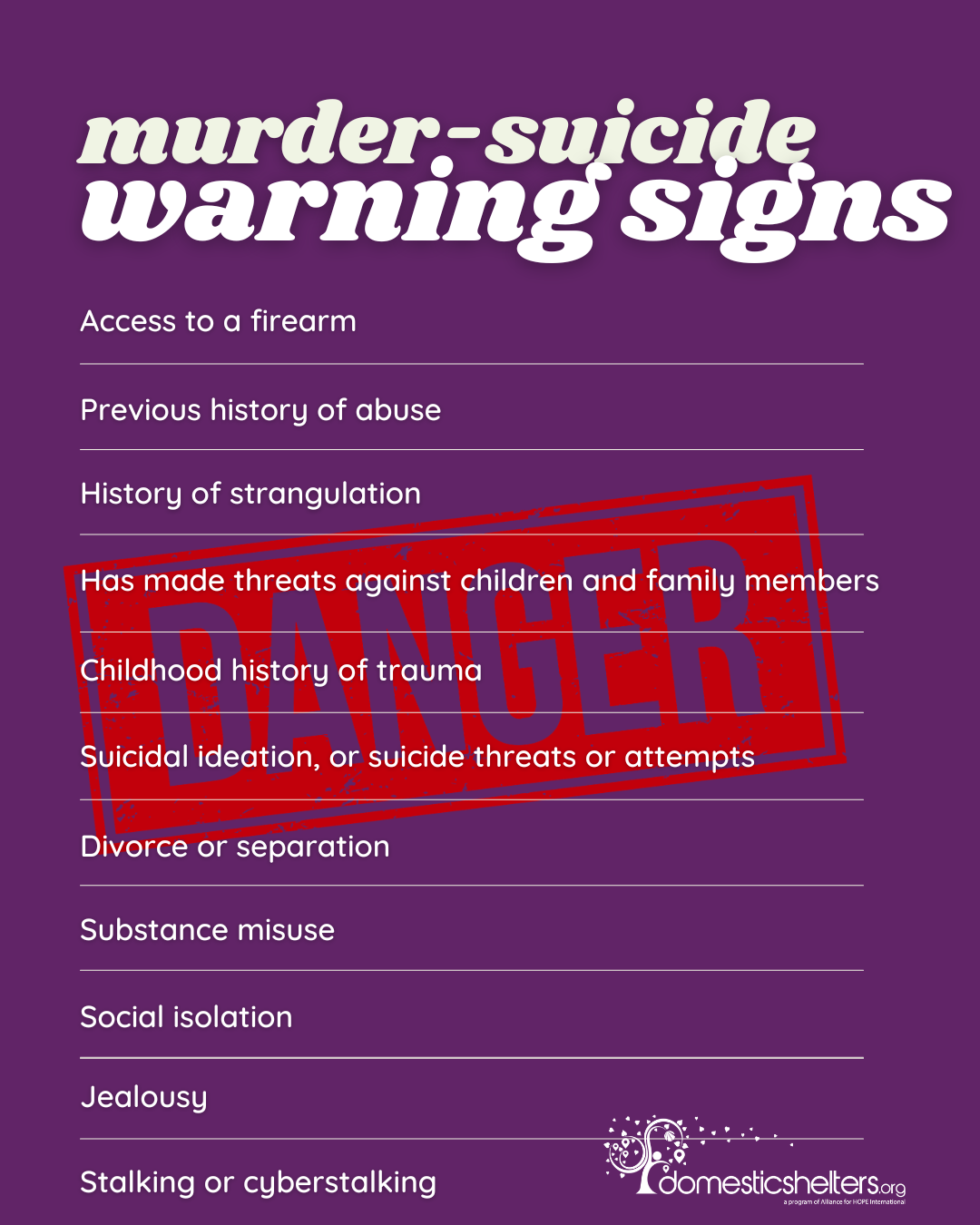
Murder-suicides are not always predictable. Some abusers will decide on this horrific course of action in a split second. Some abusive partners will plan for this in advance. In both cases, there are commonalities that the survivor and those around the survivor may be able to see that can indicate an increasingly dangerous and possibly fatal course of action.
In an Everytown for Gun Safety focus group, family members of victims killed in a murder-suicide said at least one of the following 12 warning signs existed before their loved one was murdered.
Too many times, we hear stories of a parent murdering their children before taking their own life. Abusers know this will ultimately be the most harrowing form of torture for their partner. In order to keep children safe, the protective parent should always take an abuser’s threats of harm seriously. When safety planning, consider including the children on the plan, tailoring their participation for their age. Before leaving a suicidal abuser, reach out to a trained domestic violence advocate and ask for assistance with filing an emergency child custody order and obtaining a protection order that includes the children. The abuser should not be privy to these steps before the survivor leaves. To learn more, read “How to Escape an Abuser With Your Children.”
Imminent Danger: If ever you feel like your partner is in imminent danger of suicide—i.e. they’ve said they’re planning to die by suicide, and they have the means to do so—call 911 immediately.
Less Immediate Threat: If the threat is less immediate but you’re still concerned for their safety, you can call the police non-emergency line and request a welfare check. This will cause officers to go and speak with your partner. They'll assess whether they are a threat to themselves. However, survivors should weigh this option carefully—will calling police be a safe option for the survivor after officers leave? There is a real risk of retaliation with all abusers.
Calling an Advocate First: When the threat of suicide isn’t imminent, you may also consider reaching out to a crisis counselor from the Suicide and Crisis Lifeline by calling or texting 988, or by reaching out to a domestic violence organization near you. Since suicidal threats increase a survivor’s lethality risk, or the risk that a survivor’s life is in danger. This could mean emergency shelter might be the best option.
Remember, even if you’re worried about your partner, your safety needs to come first.
It’s hard to know what to say to a person who discloses suicidal thoughts, especially when you feel like it’s being said as a manipulation tactic. On one hand, you may doubt the seriousness of the threat. On the other hand, you don’t want to see the person take their own life.
It’s normal to still care about a partner despite the abuse they may be inflicting. Most survivors just want their partner’s abuse to stop and for things to go back to how they were before the abuse began. Then again, some survivors may feel like they’re trapped indefinitely. It’s also normal to think to yourself, maybe it would be better if that person wasn’t here.
Unfortunately, as stated earlier, abusers who threaten suicide may also be thinking of homicide, so it’s important to take suicidal threats seriously. Here are some responses to avoid giving that could make things worse:
When it comes to going to court—whether it’s family court to secure child custody, civil court to sue the abuser or criminal court when charges are pressed- having more documentation of abusive tactics is always good. If the abuser is making regular suicidal threats, record these in a safe place with the date, time and details, including who was present, if the abuser had any weapons and if the threats were escalating in nature. Keep this log in a safe place where the abuser won’t find it or utilize one of these smartphone apps (often password protected) to record abuse. Many apps allow you to record audio and video of the abuse, and can call your emergency contacts or 911 for you should you need help.
“Although all suicide threats should be considered serious, it is not the survivor’s responsibility to save their abuser. If someone threatens suicide, it means they need a greater level of care than a partner can provide,” says licensed psychologist Kimber Shelton.
Even if your partner does decide to harm themself, know it’s not your fault.
“It is painful and confusing when someone ends their life,” Shelton says. “But ultimately, the decision to die by suicide is theirs. It’s natural and understandable to feel grief when this happens, but there’s no reason a survivor should feel guilt.”
Not always. Anyone can be susceptible to a mental health crisis and feel like suicide is the only solution. But in the case of an abusive partner who has inflicted other forms of power and control over a partner, such as emotional or psychological abuse, physical abuse, sexual abuse, financial abuse or spiritual abuse, threatening to die by suicide can be a type of emotional abuse. It could also be a red flag for homicide.
If you ever feel like your partner is in imminent danger of suicide—i.e., they’ve said they’re planning to die by suicide, and they have the means to do so or a weapon is in the home—call 911 immediately. If the threat is less immediate, you may first have time to leave and call a domestic violence advocate from a safe place or call the police and request a welfare check. Suicidal abusers too often also take the lives of their partners or children, and it’s important to consider your own safety first.
It’s normal to be afraid to leave an abuser. This is, unfortunately, one of the most dangerous times for a survivor. Finding the right support, developing a safety plan, securing an order of protection and being prepared to leave permanently are all important steps to help you get out safely. Read, “How Do I Leave an Abusive Relationship” for more details on these actions.
In most cases, yes. Suicide threats within the context of abuse can actually mean an abuser is planning or is capable of a murder-suicide. This is a very dangerous time for a survivor and any children in the home. When abuse escalates, an abuser is demonstrating that they have a new way to exert power over a survivor. They are more emboldened. From here, the abuse may only escalate further, and it can be harder for a survivor to leave. Read “Abuse Almost Always Escalates” for more information.
If the partner has used abusive and emotionally manipulative tactics in the past, then it’s likely they’ll try to blame you. By placing the burden of the abuser’s possible death on the survivor, the abuser knows it can keep that survivor trapped with them out of guilt, concern or shame. However, recognizing this manipulation for exactly what it is—a trap—is important. It is not your responsibility to stop a partner from dying from suicide. Offering to get them help is often the most you can do. After that, it must be their choice whether or not to take that offer. Read “Trauma-Related Guilt is a Liar” for more information.
When they are coming from an abusive partner, it’s very likely they are. The abuser can also be having a mental health crisis and seriously thinking about suicide. Both things can be true. But in many cases, for someone intent on controlling their partner, a suicide threat may be the route they choose to scare or guilt the survivor into staying or returning to the relationship.
You’re not alone if you feel trapped an abusive partner who’s been thinking of suicide. Connect with a domestic violence advocate on our Get Help page or through Hope Chat in the bottom corner of your screen to access more resources, articles and support.
Your support gives hope and help to victims of domestic violence every day.

Welcome, this is your discreet connection to help.
You are safe here.
Menstruation is an experience shared by
generations of women across the globe.
Sadly, abuse is another commonly shared experience between women.
Be it physical or psychological, abuse is not OK in any form.
Period.
You are not alone.
Help is just a few clicks away.
Welcome to DomesticShelters.org, a trusted Bright Sky US partner. On DomesticShelters.org, you will find free domestic violence resources such as:
The Bright Sky US website is still open on your browser in a separate tab, so you can return to the Bright Sky US website anytime.


