1. Select a discrete app icon.








notes

Surviving an abusive partner often requires adapting in ways that don’t always make sense to outsiders. Abuse isn’t always physical. It can include coercive control, isolation, financial abuse, threats or psychological manipulation—patterns designed to maintain power over a partner.
These adaptations—ways of coping, staying safe or mental survival strategies—eventually became the focus of psychological studies in the 1970s. That’s when the term “battered woman syndrome” was introduced. At the time, the concept helped courts begin to understand abuse as an ongoing pattern rather than isolated incidents—something the legal system had long failed to recognize.
Coined by psychologist Lenore Walker, the term described the psychological impact of repeated trauma inflicted by an intimate partner, including the survival strategies victims develop over time. It was soon used as a legal defense to help explain the mental state of women who killed their abusers.
The defense was famously implemented in the Lorena Bobbitt trial in the early ‘90s after Bobbitt castrated her abusive husband. Bobbitt was acquitted.
In 2011, Barbara Sheehan killed her husband, claiming he severely abused her throughout their marriage. She, too, was acquitted after a battered-woman defense was used. However, the Queens mother-of-two was found guilty of a weapons possession charge and ordered to serve five years at Rikers.
But the term—and what it implies about victims—has been debated ever since. While it can be used in a victim’s favor, advocates and experts would also attest that battered woman syndrome comes with its pitfalls, as assigning victims a syndrome means that they can be portrayed as having something inherently wrong with them. It’s also gendered—we know not all victims of domestic violence are women. And it can take the focus off the abuser and their choice to abuse and put a spotlight instead on a victim that supposedly just needs psychological treatment.
While not a formal diagnosis in the DSM-5, the American Psychiatric Association’s manual for mental disorders, battered woman syndrome is often understood today through the lens of post-traumatic stress disorder or PTSD. Many experts consider the term outdated or controversial, favoring PTSD as a more gender-neutral, non-blaming framework. Still, battered woman syndrome may be referenced in some clinical and legal contexts.
Symptoms of PTSD include:
 Does Battered Woman Syndrome Make Victims Kill?
Advocates and experts alike agree that so-called battered woman’s syndrome doesn’t cause women to commit murder. But the collective effects of ongoing trauma through control and abuse, coupled with a sometimes inadequate response by the systems survivors seek help from, can explain why survivors would kill their abuser as a last resort. Survivors may say that killing the abuser in self-defense was the only way to save their life, or the life of their children.
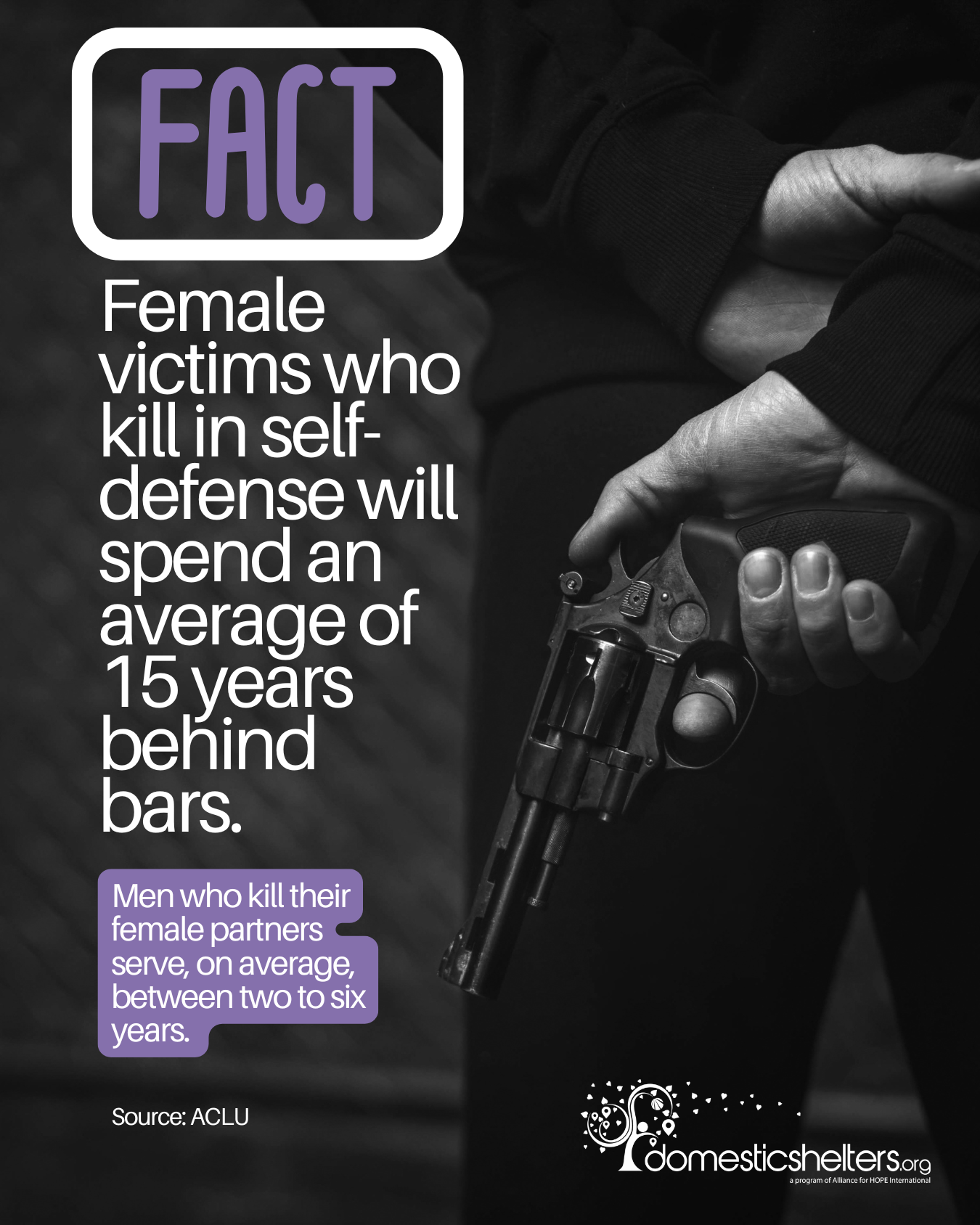
Unfortunately, female victims who kill in self-defense often receive significantly longer prison sentences than male abusers who kill their partners. According to statistics compiled by the ACLU, women who kill their partners will spend an average of 15 years behind bars, while men who kill their female partners serve much shorter sentences, on average between two to six years.
The problem often lies in the timing of the victim’s self-defense which, legally, is often viewed as the response to an underway or in-progress threat. When women kill an abuser, the narrative doesn’t fit as neatly into the self-defense paradigm we often think of, says Nora V. Demleitner, a professor of law at Washington and Lee University School of Law in Virginia who specializes in criminal justice and sentencing issues. If a woman is being attacked on the street by a stranger, and she shoots and kills them, it’s clearly self-defense. But what about the woman whose abusive husband threatens to kill her if she tries to leave, or if she tells anyone about the abuse? What if he shows her the knife, the gun or the grave he’s dug for her? What if he tells her she’ll never be free?
“In battered spouses, [danger] has been building up over time. It’s very difficult to explain that to a jury,” says Demleitner.
A survivor’s appearance in court may also not reflect what we expect a woman who just fought off an attacker looks like. Says Demleitner, “Often, the victim appears cold-blooded and intentional. That appearance reflects the trauma the victim has suffered rather than the same mental state more paradigmatic intentional killers have.”
The fact of the matter is that, traumatized or not, victims of abuse are allowed to defend themselves. Advocates argue there shouldn’t need to be a mental diagnosis of battered woman syndrome or PTSD to explain why a victim no longer wants to be abused.
Walker originally proposed that victims develop a form of “learned helplessness.” But what we understand now is more complex: survivors aren’t passive—they are navigating danger, trauma and real barriers that make leaving extraordinarily difficult. Many statistics will cite that victims try to leave an abuser seven times, on average, before staying away for good, though this is hard to prove unequivocally.
Survivor Amy told DomesticShelters.org about the “six years of hell” with her abusive husband, “I felt like a prisoner of war, just trying to survive and protect my children.” Amy tried to leave three different times, but her abusive husband would stalk her, and threaten to kill her and take her children, whom he was also physically abusive toward.
“I was in a constant state of fear and couldn’t even think clearly, so I kept going back to this horrible human being,” Amy says. “I didn’t know what to do. I didn’t understand that there were places that would help me.”
Amy told her husband that he would have to kill her if he ever hit her children again. She eventually got free when her husband was investigated and charged with a murder he committed over a decade prior.
A survey on DomesticShelters.org showed survivors weren’t able to leave abusers most often because of threats from the abuser, followed up by fear of retaliation or risk of losing custody of children. The research is clear—women want to leave abusive partners, but they need more support to do so. Too many survivors report law enforcement didn’t act when they called 911 for protection from an abuser. Survivors in marginalized communities most often encountered discrimination, with one survivor being told that murder was more of a priority than domestic violence.
With some victims winding up behind bars even after acting in self-defense, it’s critical to think about safety options before things reach that point.
When a survivor is ready to leave an abuser, safety planning is key. This document plans for any possibilities or barriers that may arise when trying to leave. It helps a survivor organize their thoughts on paper, deciding where to go, when to leave and what to take with them. Creating a safety plan can be done with a trained domestic violence advocate or on one’s own.
And, be prepared for anything: Read “When an Abuser Tries to Block Your Separation” for more information.
Some survivors may also decide to learn basic self-defense tactics. Defending Yourself 101 and Girls Fight Back offer guidance—but it’s important to recognize that self-defense, especially in the context of ongoing abuse, can be legally and emotionally complex.
If an incident occurs where the survivor has used violence in self-defense, it’s important to know how to respond if and when police arrive. Police often determine a primary aggressor when called to a domestic violence call. It’s important for survivors to try and stay as calm as possible when answering questions and make sure to talk to officers away from the abuser. If a survivor finds themselves arrested, this article, “I Got Arrested, Too. Now What?” explains what may happen next.
For additional support, visit our Get Help page to locate domestic violence organizations in your area. You can also use Hope Chat, the AI assistant at the bottom of your screen, to find articles that break down abusive tactics and offer safety guidance.
Survivors don’t need to be explained through a syndrome to be believed—they need to be heard, supported and protected before survival is treated as a crime.
Your support gives hope and help to victims of domestic violence every day.

Welcome, this is your discreet connection to help.
You are safe here.
Menstruation is an experience shared by
generations of women across the globe.
Sadly, abuse is another commonly shared experience between women.
Be it physical or psychological, abuse is not OK in any form.
Period.
You are not alone.
Help is just a few clicks away.
Welcome to DomesticShelters.org, a trusted Bright Sky US partner. On DomesticShelters.org, you will find free domestic violence resources such as:
The Bright Sky US website is still open on your browser in a separate tab, so you can return to the Bright Sky US website anytime.


